

Signs of Chronic Stress: Cortisol, Causes, and Testing (Part 1)
Chronic stress often shows up first as a change in your sleep, your mood, or your patience rather than as a feeling of being stressed. Common signs include waking at 2:00 or 3:00 in the morning with racing thoughts, irritability over small things, trouble concentrating, and losing interest in things you used to enjoy. Over time, long-term stress can also contribute to weight gain, memory problems, and ongoing fatigue. These are some of the most common patterns we see in patients who come to us about stress.
We are Dr. Steven Katz and Dr. Loreena Ryder of Naturopathic Physicians Group in Scottsdale. Stress is often treated as something to push through, or it is managed with a prescription selected from symptoms alone. Our approach is to look at how your body is actually handling stress. When you tell us you are stressed, we want to understand what that means for you: how long the pressure has lasted, how it is changing your daily life, and what else may be happening at the same time. This article opens our six-part series on stress, sleep, and resilience. It explains the difference between good stress and bad stress, the signs that your stress has become chronic, the most common causes, how cortisol works, and the testing we use to look beneath your symptoms. Part 2 continues the stress discussion with treatment.
Key Takeaways
Good stress is short-term and motivating, while bad stress is long-term and leaves you exhausted, worn out, or jittery.
Money, family, and work are the three most common causes of chronic stress we see.
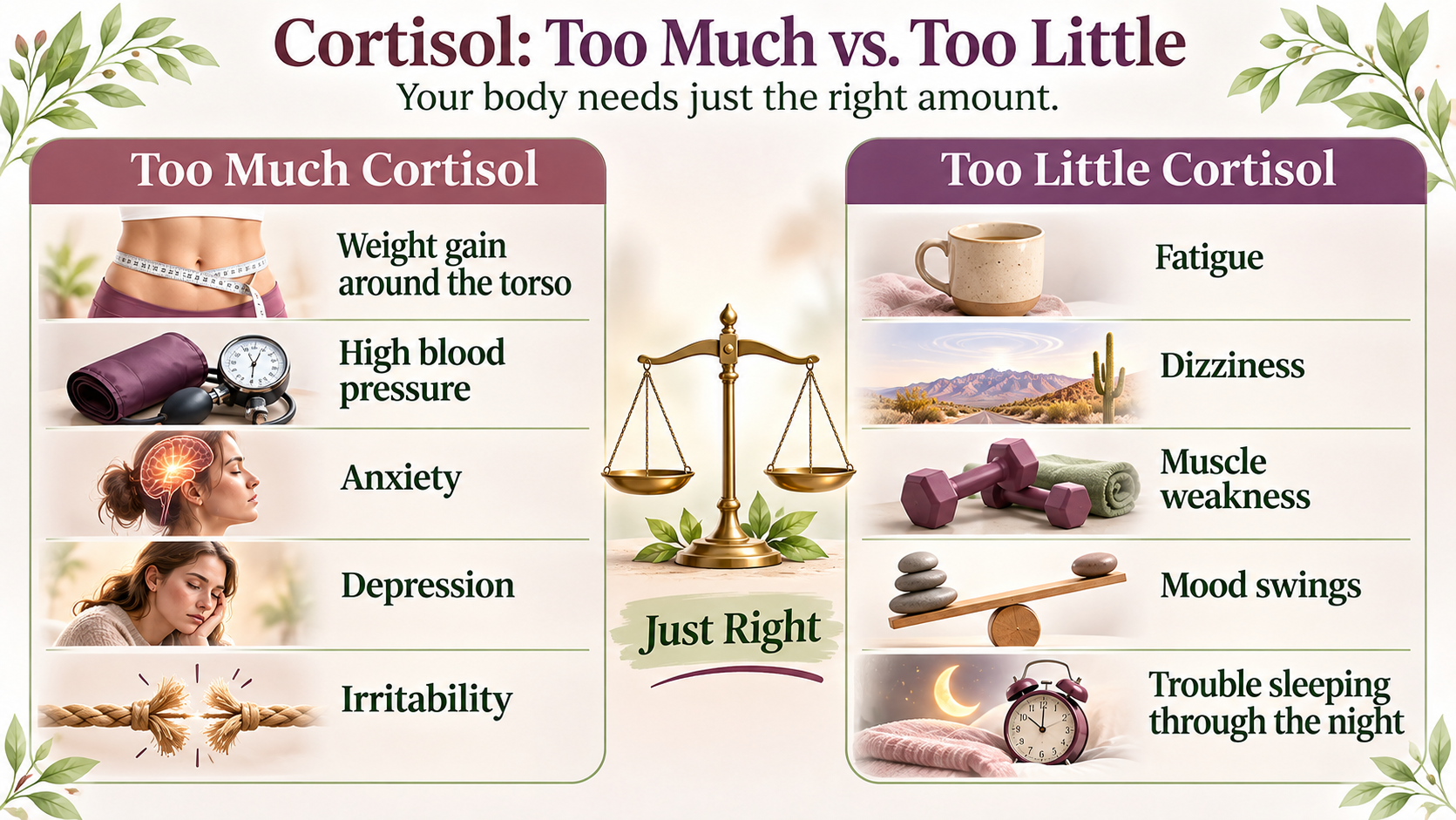
Your body needs cortisol in the right amount: too much and too little both cause symptoms, from weight gain and anxiety to fatigue and dizziness.
Psychiatry generally does not test neurotransmitters. We do, so when we put your treatment together, it is based on your actual data, not guessing.
Our testing can include cortisol across the day, a complete hormone panel, melatonin, food sensitivities, nutrients, thyroid antibodies, and heavy metals, depending on your symptoms and history.
Good Stress Versus Bad Stress
Not all stress is harmful. Stress falls into two broad types. Good stress is short-term, and it motivates you and sharpens your focus. Thrill rides, first dates, work presentations, races, games, and other competitive events can all produce it. Many people feel tense beforehand and then perform well once the event begins. Good stress ends when the event ends.
Bad stress is long-term. It leaves you exhausted, worn out, and sometimes jittery. Over time, it can contribute to weight gain, memory loss, irritability, and poor concentration. A toxic work environment that continues for months or years is a common example. Because bad stress does not end when your day ends, its effects build on one another.
What Turns Stress Into a Chronic Problem
The events that commonly set off bad stress include physical injuries, car accidents, relationship problems, losing a job, and grief after the loss of a family member or friend. The event itself is only part of the picture. How your body handles the stress is the determining factor in whether it becomes a chronic problem that starts creating other issues. Chronic stress can contribute to mental health conditions such as anxiety, along with decreased performance, poor concentration, and confusion. It can also lead to other health problems over time.
Signs Your Stress Has Become Chronic
Chronic stress tends to build slowly and show up as changes in your behavior, your mood, and your sleep. Because each change is gradual, the overall pattern is easy to miss. The signs below are the ones we see most often in our patients.
Anger, Blame, and Feeling Overwhelmed
Anger is one of the most common signs of chronic stress. Blame is another. Under sustained stress, you may look for a reason or an excuse for your situation, and the fault is placed on someone else, whether or not that is accurate. Impatience, irritability, and a sense of being overwhelmed tend to follow. Small tasks become harder. Getting out of bed, brushing your teeth, or leaving the house can feel difficult, particularly when your day ahead means returning to a stressful environment.
Racing Thoughts and 3 AM Wake-Ups
Racing thoughts that you cannot switch off are a sign of stress, and they are often most noticeable at night. Some of our patients cannot fall asleep. Others wake at 2:00 or 3:00 in the morning feeling wired and cannot fall back asleep. Some wake with racing thoughts, and some wake with panic attacks. The thoughts usually center on your to-do list, recent frustrations such as a driver who cut you off, the next day's obligations, and very often, work. Not every sleep problem is caused by stress, so we also look at when the disruption happens and what else has changed.
A clear transition between work and home can limit how much work stress carries into your evening. For both of us, a long commute serves that purpose. The drive in is time to prepare for the day, and the drive home is time to leave work behind before arriving home. Without some form of separation, work stress tends to follow you into the hours meant for rest.
Losing Your Sense of Humor, Dread, and Loneliness
Feeling depressed or unable to enjoy yourself is a sign of chronic stress. So is losing interest in life or losing your sense of humor. A persistent sense of dread, or feeling worried or tense most of the time, is another indication. Many people experienced this during 2020 and 2021. When it persists outside of a period like that, it points to ongoing stress.
Loneliness and feeling neglected are also signs, even when you live with your family. Some of our patients feel alone at home because of a lack of connection, strain in their marriage, or difficulty with their children. Existing mental health conditions add to the load, as does daily exposure to news or other content you know is upsetting to you. In each case, stress is crowding out the parts of your life that normally bring enjoyment.
The Most Common Causes of Stress
Money is the most common cause of stress our patients describe. Financial strain is also one of the leading reasons couples divorce. Family is the second most common cause, including divorce, sibling conflict, a family member who uses drugs, the death of a loved one, or caring for someone with cancer or another serious illness. Work is third. Money, work, and family often affect one another, and together they are the three most common sources of chronic stress we see.
Children and Time Pressure
Raising children is a significant source of stress, because parents carry ongoing responsibility for another person's safety and well-being. Not having enough time to meet your commitments is another major cause. Many of our patients describe a constant shortage of time for work, grocery shopping, home projects, and the rest of daily life. Even your hobbies, which are meant to relieve stress, can become a source of pressure when you have no time for them.
Chronic Illness, Trauma, and Friendships
A chronic illness or injury affects your daily life, and the ongoing attention it requires raises stress. Trauma and PTSD are also significant causes. Friendships can reduce stress or add to it. A supportive friend helps during a difficult period. Other friendships are draining, such as a friend who turns every situation toward their own problems. The length of a friendship does not determine whether it is supportive; its effect on you does.
Your personality also plays a role. If you are an introvert who recharges with time alone, social outings can be draining and stressful. If you are an extrovert who gains energy from being around people, the same situations may not feel stressful at all.

How Cortisol Works
Cortisol is a stress hormone produced by your two adrenal glands, which are triangular glands that sit on top of your kidneys. When you are stressed, more cortisol is released into your bloodstream. We often compare cortisol to the porridge in the Goldilocks story: your body needs the right amount, and producing too much or too little can both cause health problems. Symptoms can point toward a cortisol problem, but they cannot identify your cortisol level on their own.
Too Much Cortisol
Too much cortisol can lead to weight gain, particularly around your torso. It can also contribute to high blood pressure, anxiety, depression, and irritability. We see high cortisol most often in people under heavy, sustained demands, including mothers, people in high-pressure or volatile jobs, and people managing major responsibilities such as large finances. Our article on natural approaches to high blood pressure explains how cortisol fits into a blood pressure workup.
Too Little Cortisol
Too little cortisol can cause fatigue, dizziness, muscle weakness, mood swings, and difficulty sleeping through the night. Some of our patients with low cortisol describe being able to fall asleep standing up or while stopped at a red light. In our experience, ER workers, single parents, and underweight individuals can all experience low cortisol.
Shift work can also disrupt this system. Patients who have worked overnight shifts, such as 10:00 PM to 6:00 AM, often find it difficult to sleep during the day, and then difficult to return to a normal sleep schedule when their hours change. When your cortisol is low, your body struggles to function. Fatigue becomes constant, everyday stressors are harder to manage, and small problems can feel much larger.
The Bear Example: Fight or Flight
Cortisol works alongside epinephrine and norepinephrine in your fight-or-flight response. Running from a bear is an extreme example, but it shows why balance matters. With too little cortisol, your body cannot mount a response, and you freeze. With too much, you feel wired enough to stand and fight. With the right amount, you recognize the danger and run, which is the appropriate response.
Why Everyday Stress Takes a Toll
The adrenal glands produce epinephrine, also called adrenaline, along with norepinephrine and cortisol. These are the hormones that prepare you to respond to danger. In daily life, your triggers are more ordinary: traffic and long commutes, rushing when you are running late, or a difficult boss. When your stress response is working well, these events pass without lasting effects. When you are already living in a stressful environment, ordinary events become additional stressors.
The adrenal glands are designed to respond to stress occasionally, such as during heavy traffic or a demanding day at work. Modern routines place daily demands on them, and that constant demand is a large part of why chronic stress wears people down.
Cortisol and Your Other Hormones
Your body cannot survive without cortisol, and it does not make cortisol in isolation. Progesterone is a building block for cortisol, and further along the same pathway, a building block for estrogen. Because these hormones share a production pathway, we evaluate your hormones alongside your cortisol rather than looking at one number by itself. Estrogen, progesterone, and testosterone imbalances can also produce symptoms that resemble stress, so testing them together gives a clearer picture. Balancing them depends on testing correctly. Our guide to bioidentical hormone therapy covers hormone balance in more detail.
Neurotransmitters: The Testing Often Skipped Before Medication
Neurotransmitters are your brain chemicals. They help regulate stress, anxiety, sleep, depression, energy, mood, and focus. Serotonin and dopamine are the best known. Norepinephrine and epinephrine also play major roles.
When you see a psychiatrist for anxiety, depression, or OCD, a medication is often prescribed based on the symptoms you describe. Psychiatry generally does not test neurotransmitters. We do. When we put your treatment together, it is based on your actual data, not guessing.
We do not advise anyone to stop taking a medication or to stop seeing a psychiatrist or psychologist. These medications alter your brain chemistry, sometimes for many years, and we believe you benefit from having as much information as possible before starting one. Medication decisions stay with your prescribing physician.
How Cortisol Is Tested
Cortisol can be measured in blood, urine, or saliva. When we test cortisol on its own, we use a saliva test with several samples collected throughout the day, which is the more common test. When we do a full hormone check, we use a 24-hour urine collection, which also measures your cortisol across the full day. The test we use depends on what is best for you.
Your cortisol is supposed to change across the day. It should be higher during the day to wake you up and keep you going, then lower at night to calm your system so you can sleep. As you wake in the morning, it rises again and then gradually tapers through the day. That rise and fall is the normal curve.
Chronic stress can distort that curve. Some people run high all day long. Others, especially those who are worn down and fatigued, run low all day long. The saliva test collects samples when you wake up, at lunchtime, at dinnertime, and at bedtime to help map your daily curve. When a pattern shows up, treatment can be timed to the part of the day where the problem appears. This multi-point approach is how naturopathic doctors typically test cortisol.
What Standard Testing Often Misses
In conventional care, cortisol is usually tested with a single blood draw, which captures one moment that depends on what time of day your blood is drawn. More often, cortisol is not tested at all. You are referred to a psychiatrist or psychologist for evaluation, medication, or techniques such as journaling.
Your routine blood work also tends to leave out hormones, even though estrogen, progesterone, and testosterone imbalances can produce the same symptoms as stress. Vitamin D is another gap, and low vitamin D is linked to anxiety and stress. In our experience, the neurotransmitter panel described above is the test most often left out.
Naturopathic Testing for Stress
Our workup looks at the body systems that shape how you respond to stress. Because these systems influence one another, we evaluate them together rather than one at a time. Which tests are appropriate depends on your symptoms and history, and not every patient needs every test.
A Complete Hormone Panel
Conventional hormone testing for women usually covers estrogen and progesterone. Testosterone belongs in the panel too, because estrogen and testosterone communicate with each other. Some women produce too much testosterone, and some men convert too much of their testosterone into estrogen. A complete hormone check tests all of your hormones and their byproducts, which blood alone cannot do. We use a 24-hour urine collection to measure hormone metabolites, which shows where your hormones go after they are made. The same collection also measures cortisol across the full day. It can also show whether your estrogen is being metabolized into an inflammatory form, which a standard blood panel does not show.
Cortisol and Melatonin
When cortisol is tested on its own, we check it through saliva at several points across the day, as described above. Melatonin is another marker we look at, because it governs how much sleep you get. If you are low in melatonin and not sleeping well, you will feel more stressed the next day.
Food Sensitivity Testing and the Gut-Brain Connection
Food sensitivity testing connects to your brain chemistry more than most people expect. Serotonin is your calming neurotransmitter. Dopamine drives pleasure and reward. Epinephrine and norepinephrine support alertness and energy. Melatonin regulates sleep. Most of your body's serotonin is made in your digestive tract, along with a share of these other brain chemicals. When your gut is struggling, balancing your brain chemistry becomes much harder.
Many patients tell us their mood and thinking feel worse when their gut is not feeling well, which reflects the strong brain-gut connection. Food sensitivity testing is a regular part of our approach to metabolic and digestive health. For more on the digestive side, our article explaining why the IBS diagnosis isn't the whole story looks at what a gut evaluation can uncover.
Comprehensive Blood Work and a Full Thyroid Panel
Our blood panels are comprehensive, and they check for nutrient deficiencies. Our article on low iron looks at one of these deficiencies in detail. Thyroid testing includes full thyroid function plus thyroid antibodies. Thyroid hormones are hormones too, and hormones work as a family, so we evaluate female, male, and thyroid hormones together.
Heavy Metals
Heavy metals are part of our workup as well. High levels of aluminum or mercury affect your neurological pathways and your hormones. When those metals are elevated, bringing your brain chemistry and hormones back into balance becomes difficult.
Why Testing Comes Before Treatment
Stress cannot be removed from life entirely, so our focus is on how your body handles it. Medication can bring real relief, and for some people it is the right tool. Our approach is to understand what is driving your stress response before reaching for medication when other options exist, so the plan addresses the cause as well as the symptoms. When you process stress better, you can handle it much better, and you may not need a medication indefinitely.
Cortisol, hormones, brain chemistry, gut health, and nutrient levels all influence how stress shows up for you, and the pattern differs from person to person. Weight gain around the torso is one of the ways high cortisol can surface, which is part of the picture in our article on why you can't lose weight.
A whole-health assessment evaluates your cortisol, hormones, nutrients, thyroid function, and other contributing factors together. A personalized evaluation can help us determine which of these factors apply to you, based on your symptoms, lab results, history, and goals. Part 2 of this series continues with the treatment side of stress management.
When Further Evaluation Is Warranted
Racing thoughts that keep you awake, waking up wired at 2:00 or 3:00 in the morning, panic attacks, a persistent sense of dread, and losing interest in life are all signs that your stress has moved beyond the short-term kind. Fatigue, dizziness, and muscle weakness can point toward low cortisol, while weight gain around the torso, high blood pressure, and irritability can point toward high cortisol. Depression, panic attacks, and persistent insomnia can have more than one cause, so they warrant a full evaluation rather than being attributed to stress alone. If you take anti-anxiety medications or antidepressants, any changes are made with your prescribing physician, and we do not direct patients to start or stop medications. If stress ever turns into thoughts of harming yourself, the 988 Suicide and Crisis Lifeline is available 24 hours a day by call or text at 988.
This content is for educational purposes only and is not medical advice. Make treatment decisions with a qualified healthcare provider who understands your symptoms, history, labs, and goals.
FAQs
What are the signs of too much cortisol versus too little?
Too much cortisol is associated with weight gain around the torso, high blood pressure, anxiety, depression, and irritability. Too little cortisol is associated with fatigue, dizziness, muscle weakness, mood swings, and difficulty sleeping through the night. Both patterns can show up in people living with chronic stress. Testing across the day can help show which pattern applies to you.
Does feeling tired mean I have a cortisol problem?
Not necessarily. Fatigue describes how you feel; it does not show what your cortisol levels are. Interrupted sleep, shift work, demanding life circumstances, and other health issues can all contribute to fatigue. Testing your cortisol at several points across the day, on waking, at lunch, at dinner, and at bedtime, can help show whether your cortisol rhythm is part of the picture.
What is neurotransmitter testing?
Neurotransmitter testing looks at markers for brain chemicals such as serotonin, dopamine, norepinephrine, and epinephrine. Psychiatry generally does not test neurotransmitters; we do. When we put your treatment together, it is based on your actual data, not guessing. Medication decisions stay with your prescribing physician, and we do not direct anyone to start or stop a medication.
Should I change my anxiety or depression medication because I'm stressed?
Medication changes are made with the clinician who prescribed the medication, not on the basis of an article. If you have concerns about side effects, sleep, mood, or what happens when treatment changes, your prescribing clinician can weigh them against your symptoms and history. We do not direct anyone to start or stop a medication.
Why do some people wake up at 3 AM and cannot fall back asleep?
Many of our patients wake at 2:00 or 3:00 in the morning feeling wired, sometimes with racing thoughts or panic attacks. This pattern is one of the common signs of chronic stress. Disrupted cortisol and low melatonin can both affect your sleep, which is why we look at both in our workup. Not every sleep problem is caused by stress, so the timing and pattern of your sleep matter as well.
Can your gut affect your mood and stress levels?
Most of your body's serotonin is made in your digestive tract, along with a share of other brain chemicals that affect mood and sleep. When your gut is struggling, balancing your brain chemistry becomes much harder. Many of our patients notice that their mood feels worse when their digestion is off. Food sensitivity testing is one way we evaluate this brain-gut connection.
Ready to Take a Closer Look at What Your Body Is Telling You?
Dr. Steven Katz and Dr. Loreena Ryder offer personalized, root-cause evaluations for patients who are tired of being told their labs look fine.
Schedule a consultation at naturopathicgroup.com/contact
Phone: (480) 451-6161
Email: [email protected]
Location: Naturopathic Physicians Group, 9200 E. Raintree Dr., Suite 150, Scottsdale, AZ 85260