

Why You Can't Lose Weight: The Metabolic Truth Most Doctors Miss
If you have ever said, "I've tried everything, and I still can't lose weight," you are not alone, and you are not wrong. This is one of the most common things we hear from patients who walk through our doors at Naturopathic Physicians Group. They have cut calories, followed the programs, pushed through the gym, and still the scale does not move. Or it moves a little, and then it all comes back. And the worst part? Most of them have been told their labs look fine.
The truth is that weight is not just a matter of eating less and exercising more. That advice might have worked when you were 22. But your body at 42 operates completely differently. There are metabolic, hormonal, and environmental factors that conventional medicine rarely investigates. Until those issues are addressed, no diet in the world will give you lasting results.
Key Takeaways
Strategies that worked in your 20s often fail in your 40s. Your body, hormones, and metabolism have changed.
Metabolic syndrome combines high blood pressure, belly fat, elevated glucose, and abnormal cholesterol. It makes weight loss much harder.
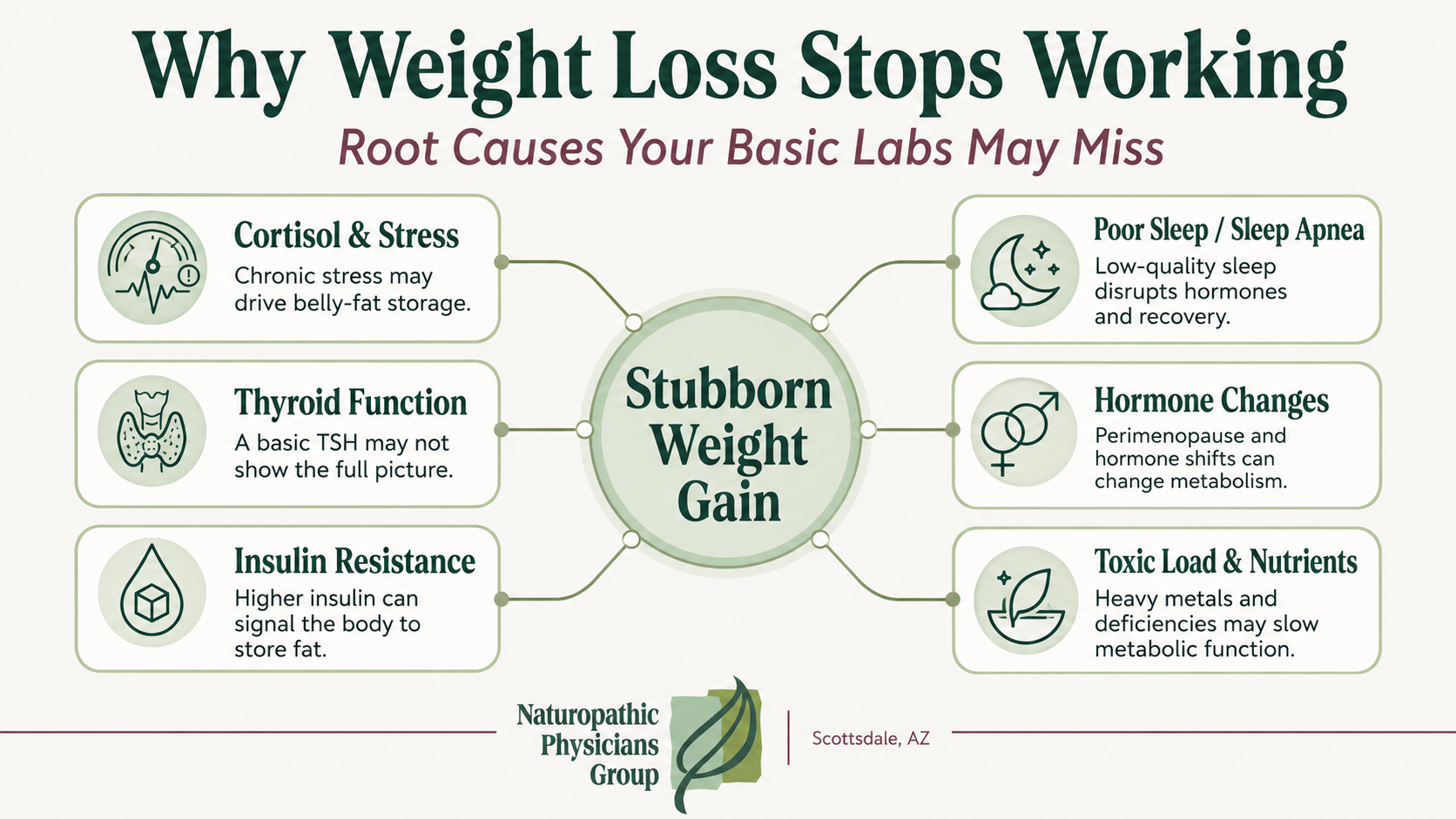
Cortisol, thyroid dysfunction, insulin resistance, and poor sleep can drive weight gain even when your eating looks normal.
Daily weigh-ins lead to discouragement. Once or twice a week tracks real progress better.
Tracking what you eat reveals more than the scale. Most people are surprised by what they actually consume.
Why Your Old Diet Doesn't Work Anymore
One of the most frustrating things we see in practice is a patient who did everything right years ago and is now doing those exact same things again and getting nowhere. The assumption is, "It worked before, so it should work again." But that is not how the body operates.
As you age, your body changes in ways that go far beyond just metabolism slowing down. Your immune function shifts. Your hormonal landscape looks different. If you have been through a pregnancy, a major illness, significant life stress, or years of poor sleep, your physiology is genuinely not the same as it was. The diet that helped you drop ten pounds before a vacation in your late 20s may now produce almost no results. Worse yet, it may cause you to gain weight because it is putting your body under stress rather than supporting it.
We hear this constantly from patients in their 40s and 50s. They are not imagining it. Their bodies are harder to shift, and the old shortcuts simply do not apply anymore.
What Is Metabolic Syndrome and Why Does It Matter?
Metabolic syndrome is a cluster of conditions that appear together and significantly increase your risk of weight gain, diabetes, and cardiovascular disease. It is also one of the primary reasons people struggle to lose weight despite their best efforts.
If you have metabolic syndrome, your body may show signs like increased blood pressure, elevated fasting blood glucose, excess weight, body fat concentrated around the waist, and abnormal cholesterol or triglyceride levels. You might notice your body shape has shifted from what it used to be. Clothes fit differently. You may feel winded doing things that used to feel easy. Your endurance may have decreased.
One of the body shape patterns associated with metabolic syndrome is what is described as an apple shape. This is where the upper torso and midsection carry more weight than the lower body. A pear shape, where the hips are larger than the upper body, can also be associated. Neither of these is a diagnosis on its own, but they are worth paying attention to alongside other symptoms.
Why Sleep Apnea Is a Weight Signal You Shouldn't Ignore
Sleep apnea is more connected to weight than most people realize. If your weight has increased over time, your airway can become partially obstructed during sleep, reducing the oxygen your body receives through the night. This affects your body's ability to heal, fight infection, regulate hormones, and maintain energy.
If you are waking up unrefreshed, snoring heavily, or if your partner has noticed that you stop breathing during sleep, these are worth investigating. Sleep apnea is not just a nuisance. It is a sign that your body may be under significant physiological stress, which makes weight management even harder.
The Role of Cortisol, Stress, and Where Fat Is Stored
Cortisol is your primary stress hormone. When your body is under chronic stress, whether that is emotional pressure, poor sleep, over-exercise, financial strain, or a difficult relationship, cortisol levels can stay elevated for extended periods. One of the side effects of elevated cortisol is that your body preferentially stores fat around the midsection.
This does not mean that belly fat automatically equals a cortisol problem. But if you are gaining weight primarily around your waist and struggling to lose it despite diet changes, cortisol is worth investigating. At the extreme end of the spectrum, there is a disease called Cushing syndrome that involves chronically excessive cortisol, but it also involves many other symptoms beyond weight gain. Simply carrying excess abdominal fat does not mean you have Cushing's. What it may mean is that stress management is part of your weight loss plan, not an optional add-on.
Stress also drives stress eating. When people are sleep-deprived or emotionally overwhelmed, they reach for comfort foods. Not vegetables. Not lean protein. Ice cream. Chips. Whatever triggers a brief feeling of relief. This is a biological response, not a lack of willpower. And it compounds the cortisol problem rather than solving it.
Hormones, Thyroid, and What Your Doctor May Not Be Checking
Hormones play a significant role in weight management, but there is an important distinction between suspecting a hormone problem and actually confirming one. Many patients come in saying, "I think it's my hormones," but have never had them properly tested. Others have had a basic panel run that missed several key markers.
Thyroid function is one of the most important things to monitor when it comes to weight. Hypothyroidism, when the thyroid is underactive, can slow metabolism and cause weight gain. Hyperthyroidism can do the opposite. Then there are autoimmune thyroid conditions like Hashimoto's and Graves' disease that involve a different layer of complexity entirely.
What we find concerning is how thyroid testing is typically handled in conventional medicine. Most primary care physicians run a single marker called TSH. TSH tells you what the brain is signaling to the thyroid, but it does not tell you what the thyroid is actually producing, converting, or how the tissues are responding. Running a full thyroid panel, including T3, T4, reverse T3, and thyroid antibodies, gives a much more complete picture. If your doctor refuses to run those additional markers when you ask, that is a meaningful signal.
The same applies to a full hormone panel. Weight is not just about estrogen or testosterone in isolation. It is about how all of the hormones relate to each other. Progesterone, cortisol, DHEA, and insulin: the balance between the whole system matters. Perimenopause, in particular, is a time when we see many patients arrive with weight complaints that seem to come out of nowhere. The hormonal shifts of that transition are real, and they affect the body's ability to manage weight in ways that pure caloric restriction cannot fix.
If you want to go deeper into how hormones interact with weight specifically, we cover this in detail in our recent series on hormone health.
Heavy Metals, Toxic Load, and a Slower Metabolism
This is a topic that rarely comes up in a conventional weight loss conversation, but it belongs in the discussion. Heavy metals like lead, mercury, cadmium, and arsenic can accumulate in tissues over time and interfere with metabolic function. If your body is carrying a significant toxic burden, it can affect how you break down and absorb nutrients and make weight loss harder.
Anyone over the age of 40 is likely carrying some level of lead simply from environmental exposure over the course of their lifetime, such as lead paint, leaded fuel, and lead pipes. The unfortunate reality is that this is not something you would know about unless you were tested.
Here is the other part that matters. Most conventional testing for heavy metals is a blood test. But heavy metals do not primarily circulate in the blood. They accumulate in tissues, bones, and organs. A normal blood test does not clear you. Proper testing typically requires a provoked urine test, which uses a chelating agent to pull metals out of tissues before measuring what is excreted. If your doctor only runs blood work and says you are fine, that does not mean the issue has been ruled out.
Nutrient Deficiencies and Why Food Alone Is Not Enough
A common question we hear is, "Can't I just get all my nutrients from food?" In an ideal world, yes. But the reality of modern food production, soil depletion, and processing means that even a reasonably healthy diet often falls short of optimal nutrient levels.
When specific nutrients are deficient, your body's metabolic processes can be impaired. This includes how you convert food to energy, how your thyroid functions, how your hormones are produced and regulated, and how well your cells respond to insulin. Nutrient deficiencies can be quiet contributors to weight struggles that never show up on a basic blood panel.

Insulin Resistance, Diabetes, and the Weight Connection
Insulin resistance is a condition where your cells become less responsive to the hormone insulin, which is responsible for helping glucose enter your cells for energy. When insulin resistance develops, your body compensates by producing more insulin, which in turn can drive fat storage, particularly around the abdomen.
Type 2 diabetes often develops from longstanding insulin resistance, and once diabetes is present, losing weight becomes even more difficult. Some of the medications used to treat diabetes, including insulin itself, can further complicate weight management as a side effect.
This does not mean the situation is hopeless. There are naturopathic approaches, supplements, and in some cases, medications that can help address insulin resistance as a root cause rather than just managing blood sugar as a symptom. Part 2 of this series will go deeper into the naturopathic solutions. For now, the key point is that if insulin has never been included in your lab work, it should be.
What You're Eating Matters More Than How Much
The standard American diet, which Dr. Katz and Dr. Ryder have described as appropriately abbreviated SAD, tends to be heavily skewed toward omega-6 fatty acids and away from omega-3 fatty acids. Your body functions best at a ratio of roughly 4 to 6 omega-6s for every 1 omega-3. The standard American diet often runs closer to 14 or 16 to 1, meaning most people are running a significantly higher inflammatory load than their bodies were designed to handle.
Omega-6 fatty acids are found in large quantities in processed foods, refined cooking oils like canola and sunflower oil, and fast food. Omega-3 fatty acids, the anti-inflammatory counterpart, come from sources like fatty fish, flaxseed, and walnuts. Fish oil supplements are popular precisely because people are trying to shift this ratio without actually addressing the dietary root of the imbalance.
Calories matter, but they are not the whole story. One gram of protein provides four calories. One gram of carbohydrates provides four calories. One gram of fat provides nine calories. These numbers treat all sources equally, but a gram of refined sugar and a gram of fruit are not the same in terms of what they do in your body. Caloric restriction can work for weight loss, but if you are not eating the right nutrients while restricting, you risk burning muscle rather than fat and creating deficiencies that slow your metabolism further.
A general reference point for maintenance calories is 1,600 to 2,400 per day for women and 2,000 to 3,000 for men, depending on activity level, age, and current body composition. These numbers shift if weight loss is the goal, but they are a reasonable baseline for comparison.
Should You Weigh Yourself Every Day?
No. And this is worth explaining carefully, because daily weigh-ins are one of the most common habits that lead people to abandon their efforts too soon.
Your weight fluctuates throughout the day and from one morning to the next based on what you ate, how much water you drank, how far along you are in digestion, and other factors that have nothing to do with actual fat loss or gain. The typical digestive cycle runs 16 to 20 hours, which means the dinner you ate last night may still be actively moving through your system when you step on the scale in the morning. Even if you weigh yourself under consistent conditions at the same time, no clothes, before eating, you will see natural variation that can feel discouraging if you interpret it as progress or failure.
Weighing yourself once or twice a week is enough. Healthy fat loss for most people averages one to two pounds per week. If you check daily, you will have multiple days of no change or slight gains that are not real, and for many people, that is the moment they quit.
Tracking your food intake is far more useful than obsessing over the scale. When patients start logging what they eat before they have even changed anything, they almost always discover their diet looks significantly different on paper than it did in their memory. That is not a judgment. It is just how memory works. Seeing your actual intake is the foundation for making meaningful changes.
What Labs Should You Actually Ask For?
When a patient comes in with weight concerns, a thorough workup includes more than a standard metabolic panel. At a minimum, you would want to look at:
CBC (complete blood count) to assess red and white blood cells
CMP (comprehensive metabolic panel) for kidney and liver function
Insulin is frequently omitted by conventional physicians, but it is essential for assessing insulin resistance
Hemoglobin A1C for blood sugar regulation over the past three months
Lipid panel for cholesterol and triglycerides
Full thyroid panel not just TSH, but T3, T4, reverse T3, and thyroid antibodies
Full hormone panel including cortisol, DHEA, estrogen, progesterone, and testosterone
Heavy metal testing if there is any reason to suspect a toxic load
If your current physician will not run a full thyroid panel or include insulin in your labs, that is important information. You deserve a complete picture.
Conventional Approaches: What Traditional Medicine Offers
For context, it is worth understanding what conventional medicine typically reaches for when a patient presents with weight concerns.
Appetite suppressant medications like phentermine are stimulant-based drugs that curb appetite. They are controlled substances and carry significant side effect risks, including anxiety and cardiovascular strain. They have their place in specific clinical situations after other options have been exhausted, but they are not a root-cause solution.
GLP-1 medications like semaglutide (Ozempic, Wegovy) and liraglutide (Saxenda) work by mimicking a gut hormone that signals the brain that the stomach is full, thereby reducing appetite and slowing gastric emptying. These were originally developed for Type 2 diabetes and have since been adopted widely for weight management. They can be effective for some patients and have legitimate clinical applications. They also carry a meaningful side effect profile and are not appropriate for everyone. The concern is not with the medications themselves in appropriate cases, but with how broadly and quickly they are being prescribed without investigating underlying causes.
Bariatric procedures, including gastric bypass, gastric sleeve, and lap band surgery, physically reduce stomach capacity and, in some cases, alter the digestive pathway. Weight loss following these procedures can be significant and rapid. However, these surgeries do not eliminate the need for lifestyle change, and the long-term consequences of reducing digestive capacity are real. B12 production, stomach acid, and nutrient absorption are all affected. Many patients require lifelong supplementation, and those who do not take this seriously may develop chronic conditions years later that trace back to nutrient malabsorption. The lap band is the most reversible option and involves no cutting, which makes it the least invasive starting point for patients who are considering a surgical route.
The overarching pattern in conventional treatment is a focus on suppressing appetite or physically restricting intake without addressing the metabolic, hormonal, and environmental factors that drove the weight gain in the first place.
What Comes Next
This is Part 1 of a two-part series on weight loss. We have covered the landscape of why people struggle and what the body is dealing with when weight becomes resistant to change. Part 2 focuses on what we actually do in naturopathic medicine to address these root causes and how that differs from what conventional medicine offers.
If you are exhausted from trying things that do not work and are ready to understand what is actually happening in your body, that is exactly who we see at Naturopathic Physicians Group. The answers exist. They just require the right questions.
You can also learn more about our approach to metabolic and digestive health and what a root-cause evaluation looks like.
Frequently Asked Questions
Why can't I lose weight even when I eat less?
Eating less is only one variable. If your thyroid is underperforming, your cortisol is elevated, your insulin is dysregulated, or your body is carrying a significant toxic burden, reducing calories may not be enough to move the scale. A thorough evaluation of your labs, hormones, and metabolic function can reveal what is actually standing in the way.
Is metabolic syndrome reversible?
The underlying contributors to metabolic syndrome, including insulin resistance, elevated blood pressure, and abnormal cholesterol, can often be improved with the right interventions. This is something best evaluated with a provider who looks at root causes rather than managing each symptom separately.
How do I know if my thyroid is affecting my weight?
Symptoms of an underactive thyroid can include fatigue, cold intolerance, hair thinning, constipation, and weight gain that does not respond to diet changes. But symptoms alone are not enough to diagnose thyroid dysfunction. A full thyroid panel, not just TSH, is the appropriate way to assess thyroid function accurately.
Should I take a GLP-1 medication like Ozempic to lose weight?
GLP-1 medications can be appropriate in certain clinical situations, but they are not a root-cause solution for most people struggling with weight. Before considering this route, a full evaluation of your metabolic health, hormones, and lifestyle factors will give you a clearer picture of whether medication is actually what you need or whether there are underlying issues that can be addressed more directly.
How do I get started with a naturopathic weight loss evaluation?
The best first step is scheduling a consultation with Dr. Katz or Dr. Ryder at Naturopathic Physicians Group. They offer both in-person and virtual appointments. During an initial evaluation, they will review your history, symptoms, and labs to identify what is actually driving your weight challenges.
Ready to take a closer look at what your body is telling you? Dr. Steven Katz and Dr. Loreena Ryder offer personalized, root-cause evaluations for patients who are tired of being told their labs look fine.
Schedule a consultation at naturopathicgroup.com/contact
Phone: (480) 451-6161
Email: [email protected]
Location: Naturopathic Physicians Group, 9200 E. Raintree Dr., Suite 150, Scottsdale, AZ 85260
This content is for educational purposes only and is not medical advice. Treatment decisions should be made with a qualified healthcare provider who understands your symptoms, history, labs, and goals.