

Is Your Hormone Therapy Actually Bioidentical? What Most Patients Are Never Told
If your doctor told you that you're on bioidentical hormones, you believed them. Why wouldn't you? They're your doctor. But here's something we see regularly at Naturopathic Physicians Group in Scottsdale: patients come in holding prescriptions they filled at a chain pharmacy, fully confident they're on bioidentical hormone therapy. When we dig into it, what they're actually taking is a synthetically modified version of a hormone that their body has to work much harder to process. That distinction matters more than most people realize, and it may help explain why so many patients still don't feel right even after starting hormone therapy.
You are not imagining your symptoms. Fatigue, mood swings, poor sleep, low libido, weight gain, and brain fog. These are real, measurable, hormonal issues. The problem is not that hormone therapy doesn't work. The problem is often that the type of hormone therapy you received was never designed with your body specifically in mind.
Key Takeaways
Truly bioidentical hormones are derived from all-natural sources and are molecularly identical to the hormones your body makes naturally.
Many hormones dispensed at conventional pharmacies are synthetically modified in labs and may not behave the same way in your body.
DHEA, testosterone, estrogen, and progesterone all need to be in balance. Treating one without checking the others can create new problems.
Compounded hormone therapy is individually formulated to your exact dose, delivery method, and needs, unlike one-size-fits-all retail prescriptions.
How a hormone is delivered into your body, whether cream, lozenge, or capsule, affects how much of it actually reaches your bloodstream.
When Hormones Go Off Balance, Everything Feels Off
Hormones are not just about sex drive or menopause. They are chemical messengers that regulate nearly every system in your body, including your energy, mood, sleep, weight, bone density, cardiovascular health, and mental clarity. When they fall out of balance, the effects can be wide-ranging and deeply frustrating to live with.
What most patients don't know is that their hormones are made from cholesterol. Not fat, not supplements. Cholesterol is the raw material your adrenal glands use to produce your sex hormones, including DHEA, testosterone, all three forms of estrogen, and progesterone. This is one reason why statin medications, which are prescribed to lower cholesterol, may be associated with side effects like fatigue, low libido, anxiety, and erectile dysfunction in men. If your body doesn't have adequate cholesterol available, your adrenal glands may struggle to produce the hormones you need.
Hormone imbalance doesn't always look the way you expect it to. It doesn't always announce itself with dramatic hot flashes or obvious symptoms. For many patients, it shows up as a slow, creeping decline in how they feel. Energy that used to be steady now crashes by early afternoon. Sleep that used to come easily now feels elusive. A mood that used to be stable now swings without warning. A body that used to respond to diet and exercise now seems to resist every effort. If any of that sounds familiar, your hormones may be part of the story.
The Four Hormones at the Center of How You Feel
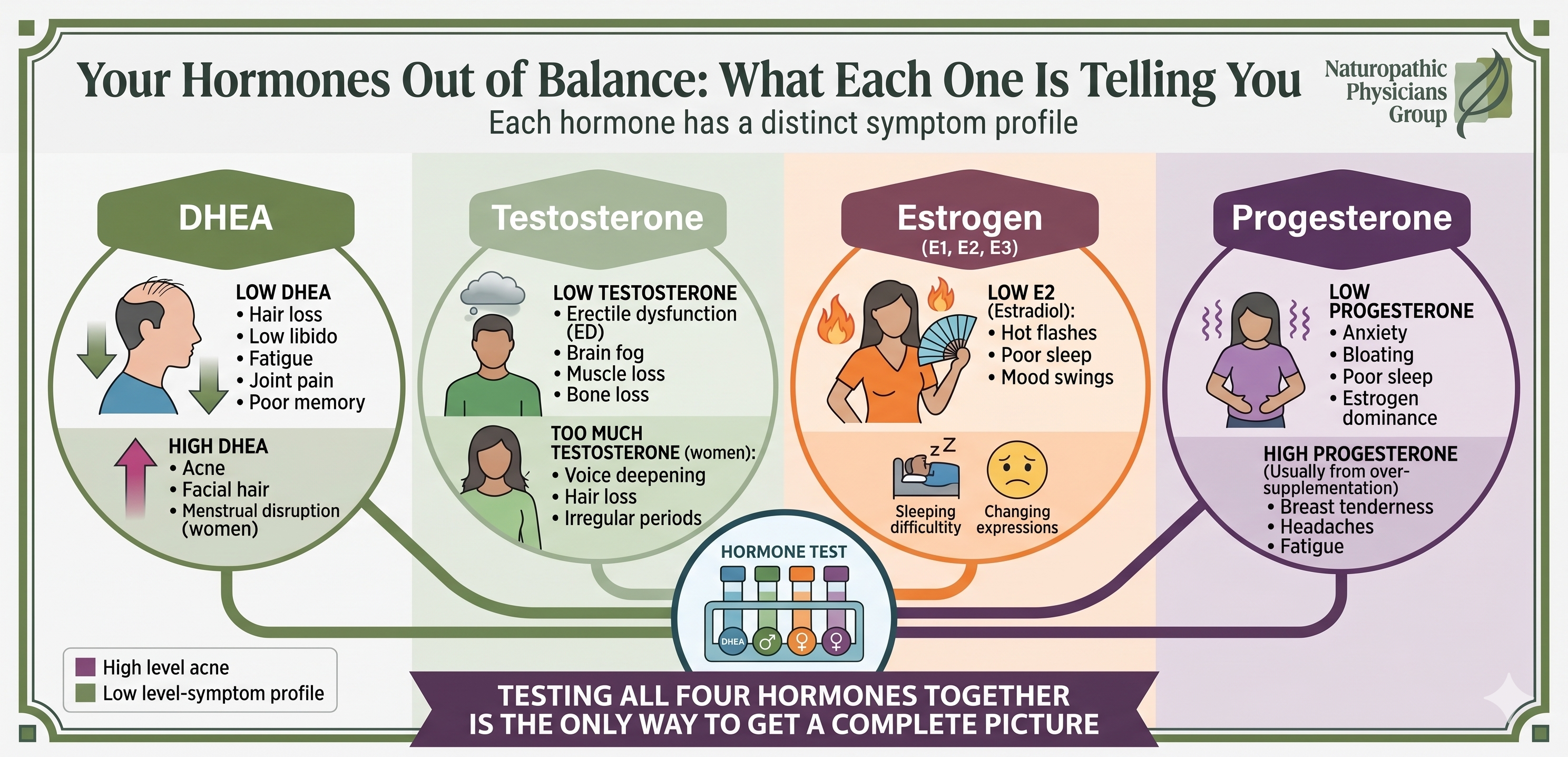
Understanding what each of your key sex hormones does, and what happens when they are out of range, is the foundation of everything else. Dr. Steven Katz and Dr. Loreena Ryder discuss all four in detail in this episode, and each one tells a different part of the same story.
DHEA is often called the forgotten hormone because it rarely gets discussed, even by doctors who are actively treating hormone imbalance. DHEA is a precursor to testosterone, which means your body uses it as a building block to produce testosterone. Low DHEA may show up as hair loss, dry skin, dry eyes, low libido, fatigue, poor memory, joint pain, and disrupted sleep. It also plays a meaningful role in bone health, so patients who have been told they have osteopenia or osteoporosis may want to ask their provider about DHEA levels specifically. Too much DHEA, particularly in women, can push testosterone too high and cause acne, facial hair growth, menstrual disruption, and irritability. The point is that DHEA matters in both directions, and skipping straight to testosterone therapy without evaluating DHEA first may mean you are treating a downstream effect rather than the actual root cause.
Testosterone affects both men and women, though in different amounts. In men, low testosterone may be associated with reduced libido, erectile dysfunction, brain fog, decreased muscle mass, increased body fat, hot flashes, night sweats, and bone loss. In women, too much testosterone, often driven by excess DHEA, can cause many of those same virilizing symptoms described above. One important point for men considering testosterone therapy: your body can convert testosterone into estrogen through a process called aromatization. If dosing is not carefully managed, you may end up with elevated estrogen, which can cause symptoms like gynecomastia and worsen the very issues you were trying to address. More is not better. Balance is better.
Estrogen is not a single hormone. It is three. E1, known as estrone, is the most common form found in post-menopausal women. Keeping E1 in check is especially important for women with a personal or family history of hormone-sensitive cancers. E2, known as estradiol, is the primary reproductive estrogen. Its decline during perimenopause and menopause is what drives hot flashes, mood swings, poor sleep, decreased libido, painful intercourse, and increased risk of osteoporosis and cardiovascular disease. E3, known as estriol, is the protective, anti-inflammatory estrogen. At NPG, Dr. Ryder and Dr. Katz prefer to balance E2 with E3 because estriol may help keep the more inflammatory estrogens in check. Favoring anti-inflammatory estrogens over inflammatory ones is also associated with a more protective profile when it comes to breast and ovarian health.
Progesterone is Dr. Ryder's favorite hormone, and once you understand what it does, it is easy to see why. She calls it the happy hormone. Progesterone is naturally anti-anxiety, anti-bloat and acts as a key balancer of estrogen. Patients with estrogen dominance, endometriosis, ovarian cysts, fibroids, or a history of recurrent miscarriages may benefit significantly from having their progesterone levels evaluated and supported. Progesterone also relaxes blood vessels, which means low levels may be a contributing factor for some patients experiencing elevated blood pressure. And if you have always been a good sleeper but suddenly cannot sleep since entering perimenopause or menopause, low progesterone is one of the first things Dr. Katz and Dr. Ryder investigate. One less commonly known fact: when your body is under high stress, it can convert progesterone into cortisol to meet the demand. This means chronic stress does not just deplete your energy. It may also deplete the very hormone that was keeping your estrogen balanced and your sleep intact.
What "Bioidentical" Actually Means, and Why It Matters
Here is where the most common and costly misconception comes in. Truly bioidentical hormones are derived from natural sources, often yams, and are molecularly identical to the hormones your body produces naturally. When your body receives them, it recognizes and processes them the same way it would hormones it made itself.
What many conventional pharmacies dispense is something different. These are synthetically derived hormones that have been chemically modified in laboratory settings to extend shelf life. According to compounding pharmacist Dr. Corey Castorline of Raintree Apothecary in Scottsdale, these modifications require your body to do extra work to process the hormone before it can be used. That process may produce byproducts that tax the body in ways that truly bioidentical hormones do not. Some conventional hormone sources have historically been derived from animal sources, including horse urine. This is not the same as a plant-derived compound formulated to match your body's own hormonal signature.
The label "bioidentical" has unfortunately become a marketing term that does not always reflect the actual formulation. When a patient fills a hormone prescription at a retail chain pharmacy, even if their doctor used the word bioidentical, what they receive is a standardized commercial product manufactured at a fixed dose for a broad population. It is not formulated specifically for them. It has not been adjusted to their labs, their symptoms, their history, or their goals.
Compounded bioidentical hormone therapy, prepared by a licensed compounding pharmacy like Raintree Apothecary, is a different thing entirely. Each prescription is made individually based on what the prescribing doctor has ordered for that specific patient. The dose is customized. The delivery method is customized. Even the ingredients can be adjusted to remove allergens like peanut oil or gluten-derived fillers that may be present in commercial formulations. For patients who have not responded well to standard hormone therapy or who continue to feel symptoms despite being on treatment, this level of customization may be exactly what has been missing.
This content is for educational purposes only and is not medical advice. Treatment decisions should be made with a qualified healthcare provider who understands your symptoms, history, labs, and goals.
Why Delivery Method Changes Everything

Not all hormone delivery methods are created equal. This is a detail that often gets overlooked but has a real impact on how effectively your body uses what you are taking.
Capsules, which are common in conventional hormone prescriptions, have relatively low bioavailability. Dr. Castorline noted that oral capsule formulations may achieve only around ten percent bioavailability for hormones like testosterone and estrogen. This means your body may only be absorbing a fraction of the dose you are actually taking, and the rest passes through without being used.
Creams and lozenges bypass first-pass metabolism through the liver, which means the hormone goes directly into your bloodstream rather than being partially broken down before it can be used. This makes them significantly more efficient delivery systems for many patients. Creams also offer a practical dosing advantage: adjusting your dose is as simple as adding or subtracting a click on the pump. That level of precision is not possible with a capsule. Dr. Katz has found that the majority of his patients do well with creams, and Dr. Castorline noted that lozenges can also be easily quartered or halved to fine-tune dosing without needing a new prescription.
Pellets, which are a popular option at many conventional and integrative clinics, work differently. They deliver a large dose at once, and patients often feel great initially. But as the pellet depletes over weeks, hormone levels can drop significantly before the next insertion is due. This creates a rollercoaster effect that many patients find difficult to manage. For patients who are used to stable energy, mood, and sleep, that kind of fluctuation can feel just as disruptive as the original hormonal imbalance.
What to Ask Before You Start Any Hormone Therapy
If you are currently on hormone therapy or considering it, here are the questions worth asking your provider before you move forward.
Where will this prescription be filled? If the answer is a chain pharmacy, ask specifically whether the formulation is compounded and plant-derived, or commercially manufactured and synthetically modified. The distinction matters, and you are entitled to a clear answer.
Has my full hormone panel been tested? A comprehensive hormone evaluation should include DHEA, testosterone, all three estrogens, and progesterone at a minimum. Treating one hormone without understanding where the others stand can create new imbalances. Some patients start testosterone therapy only to find that their real deficiency was in DHEA, or that elevated cortisol from chronic stress was depleting their progesterone.
What delivery method is being recommended and why? If you are being offered a one-size-fits-all dose in a format that does not account for your absorption, your lifestyle, or your sensitivity to ingredients, that is a conversation worth having before you fill the prescription.
Is anyone monitoring my levels after I start? Bioidentical hormone therapy is not a set-it-and-forget-it solution. Levels need to be monitored and doses adjusted over time as your body changes. A provider who sets you up with a starting dose and does not follow up is leaving a critical part of the process incomplete.
Frequently Asked Questions
What is the difference between bioidentical and synthetic hormones?
Bioidentical hormones are derived from plant sources and are molecularly identical to the hormones your body produces. Synthetic hormones are chemically modified in laboratory settings and may not be processed by your body in the same way. The distinction affects how your body absorbs and responds to the hormone, and may influence the side effect profile over time.
Can I get bioidentical hormones at a regular pharmacy?
Most chain pharmacies carry commercially manufactured hormone products that may be described as bioidentical by some providers, but these are not the same as individually compounded bioidentical hormones prepared by a licensed compounding pharmacy. Truly compounded bioidentical hormones are formulated to your specific prescription and are not available off the shelf.
Why do I still have symptoms if I'm already on hormone therapy?
There are several possible reasons. Your dose may not be right for your body. The delivery method you are using may have lower bioavailability than alternatives. Your full hormone panel may not have been evaluated before treatment began. Or the product you received may not be truly bioidentical. A comprehensive evaluation with a provider who specializes in hormone health can help identify what is missing.
Is compounded hormone therapy covered by insurance?
Most insurance plans do not cover compounded hormone prescriptions, as they prefer to direct patients toward commercially available products on their formulary. Compounded hormone therapy is typically cash pay. Many patients consider it an investment in their long-term health, particularly after years of treatments that did not fully address their symptoms.
Who is a good candidate for bioidentical hormone therapy?
Anyone experiencing symptoms that may be related to hormonal imbalance, including fatigue, poor sleep, low libido, mood changes, weight changes, brain fog, or bone loss, may benefit from a comprehensive hormone evaluation. The right candidate depends on symptoms, labs, health history, and goals. A personalized consultation can help determine whether bioidentical hormone therapy is an appropriate option for you.
Take the Next Step
Ready to take a closer look at what your body is telling you? Dr. Steven Katz and Dr. Loreena Ryder offer personalized, root-cause evaluations for patients who are tired of being told their labs look fine.
Schedule a consultation at naturopathicgroup.com/contact
Phone: (480) 451-6161
Email: [email protected]
Location: Naturopathic Physicians Group, Scottsdale, Arizona
This content is for educational purposes only and is not medical advice. Treatment decisions should be made with a qualified healthcare provider who understands your symptoms, history, labs, and goals.