

The IBS Diagnosis Isn't the Whole Story
If you have been dealing with digestive problems for years, you probably know the routine by now. You describe your symptoms to your doctor. You get a prescription or an over-the-counter recommendation. Maybe you get sent for testing. And somewhere along the way, someone tells you that you "just have IBS" and there is not much more to do about it. That answer may be common, but it is not the whole story.
At Naturopathic Physicians Group, we see patients every week who have been living with bloating, constipation, diarrhea, acid reflux, or abdominal discomfort for years, sometimes decades. Many of them have had endoscopies, colonoscopies, and stool tests. Some have a diagnosis. Some do not. What almost none of them have received is a real answer to the question that matters most: what is actually causing this? That is the question we are here to answer.
Key Takeaways
About 80% of your immune system is regulated by your GI tract, meaning gut problems can show up as symptoms you would never connect to digestion, including poor sleep, brain fog, and skin conditions.
The most common cause of IBS and other digestive conditions is food, specifically delayed food sensitivities that standard allergy tests do not catch.
IgG blood serum testing identifies delayed food reactions that can take up to three days to appear, making elimination diets unreliable on their own.
A comprehensive stool test checks for pathogens, parasites, fungi, and beneficial bacteria levels, not just whether harmful bacteria is present.
Gluten, dairy, and eggs are the three most common food sensitivities found on food allergy panels, and many patients notice improvement within a week of removing them.
Your GI Tract Does More Than You Think
Most people think of the digestive system as a one-purpose organ: you eat food, it gets processed, and the rest is straightforward. The reality is significantly more complex, and understanding it changes how you think about every symptom you have been managing for years.
About 80% of your immune system is regulated by your gastrointestinal tract. That is not a small detail. It means that when your gut is out of balance, the effects can ripple far beyond your stomach. You may experience symptoms that seem to have nothing to do with digestion at all, including recurring skin problems, chronic infections, joint pain, fatigue, and even anxiety.
The sleep connection surprises most patients. About 80% of the melatonin produced in your body is made in your digestive tract, not your brain. If you are lying awake at night despite doing everything right, the answer may not be in your bedroom routine. It may be in what you are eating. If sleep is a persistent struggle for you, we explored the relationship between poor sleep and your overall health in our post on what happens when you don't fix your sleep.
Then there is the gut-brain connection. Mental health, anxiety, and mood regulation are all closely tied to gut health. Many patients come to us focused on one set of symptoms and leave with a much broader understanding of how their gut has been affecting systems they had never considered. That is why, at Naturopathic Physicians Group, our approach always starts with a complete picture of what is going on in your body, not just the symptom in front of us.
Why the Standard Approach Often Leaves You Without Answers
If you have seen a gastroenterologist or a primary care physician for ongoing GI symptoms, your experience likely followed a predictable path. You described what was happening. You were sent for testing. Perhaps you had an endoscopy, where a scope examines your esophagus and stomach. Perhaps you had a colonoscopy as well. Both are valuable tests. They are excellent at identifying your diagnosis.
The problem is that a diagnosis is only one piece of the puzzle. Knowing that you have Crohn's disease or ulcerative colitis or acid reflux is important. Knowing why your body developed it is equally important, and that second question is where conventional medicine often stops.
Dr. Katz spent time working in a pharmacy before becoming a naturopathic physician. He watched patients receive prescriptions for acid reflux medications, specifically proton pump inhibitors like Prilosec, Prevacid, and Nexium, over and over, often for months or years at a time. The labels on these medications state clearly that they should not be taken for longer than six to eight weeks. Despite that, many patients continue using them for years because they were never given a root-cause solution.
Long-term use of acid blockers can reduce your body's ability to produce the hydrochloric acid it needs to digest food properly. Over time, this may create a dependency rather than a resolution. Your gut becomes less capable of doing its job on its own, and the suppression also affects your ability to absorb B12 and other nutrients that your gut needs to function. This is not a criticism of conventional care. It is an explanation of why root-cause medicine exists, and why so many patients eventually find their way to a naturopathic physician after years of managing symptoms that never fully go away.
The Most Common Cause of GI Problems Is Something You Eat Every Day
This may be the most important thing we can tell you: in our clinical experience, the most common underlying cause of IBS, acid reflux, chronic bloating, constipation, diarrhea, and many other GI conditions is food. Not a mysterious pathogen. Not a genetic inevitability. Food.
That sounds simple. It is not always easy to hear, because the food causing your symptoms may be something you have been eating your entire life and have never once connected to how you feel. You could eat something in the morning and not experience a reaction until late afternoon or the following day. Digestion is a long, complex process, and by the time your body responds to something it does not tolerate, you have eaten two or three more meals since.
This delay is one reason why people discount food as a cause. They say, "I eat this all the time, and I feel fine." That may not be accurate. Your body may be reacting to something slowly and chronically rather than in the immediate, dramatic way most people associate with food allergies.
There is also the question of what "healthy eating" actually means. Organic labeling and gluten-free products are marketed heavily, but they do not automatically mean your body tolerates them. You can find gluten-free breakfast cereals loaded with sugar. You can find organic corn syrup. Organic means the food was grown without certain pesticides. It does not mean it is right for your gut. Eating for your gut health means understanding what your specific body reacts to, which requires specific testing rather than general assumptions.
Why the Standard Food Allergy Test Often Misses the Problem
If you have ever been to an allergist for food sensitivity testing, you likely received a skin prick test. Small amounts of food proteins are introduced under the skin, and a reaction indicates an allergy. This test checks for IgE antibodies, which are the immunoglobulins associated with immediate allergic responses. These are the reactions that happen within minutes.
Here is what that test does not catch: most food sensitivities are not IgE reactions. Immediate IgE responses account for roughly 15 to 20% of actual food reactions. The remaining 80 to 85% are delayed responses driven by IgG antibodies, which are immunoglobulins associated with sensitivities that develop over time. These reactions may not appear until hours or even up to three days after you eat the offending food.
When patients get a skin prick test and come back negative for food reactions, they are often told their food is not the issue. But that result only addresses one small fraction of how the immune system responds to food. The delayed reactions, the ones most likely driving chronic GI symptoms, are not being measured at all.
This is also why elimination diets, while well-intentioned, are unreliable on their own. When you do an elimination diet without knowing what your body is actually reacting to, it is like playing darts without a dartboard. You may remove the right foods by chance, or you may miss them entirely. We have seen patients with high reactivity to cucumbers and almonds, foods most people consider completely healthy. If you switched to almond milk because you are lactose intolerant, but almonds are actually your sensitivity, you have not solved the problem. You have replaced it.
The Testing We Use and What It Actually Tells Us
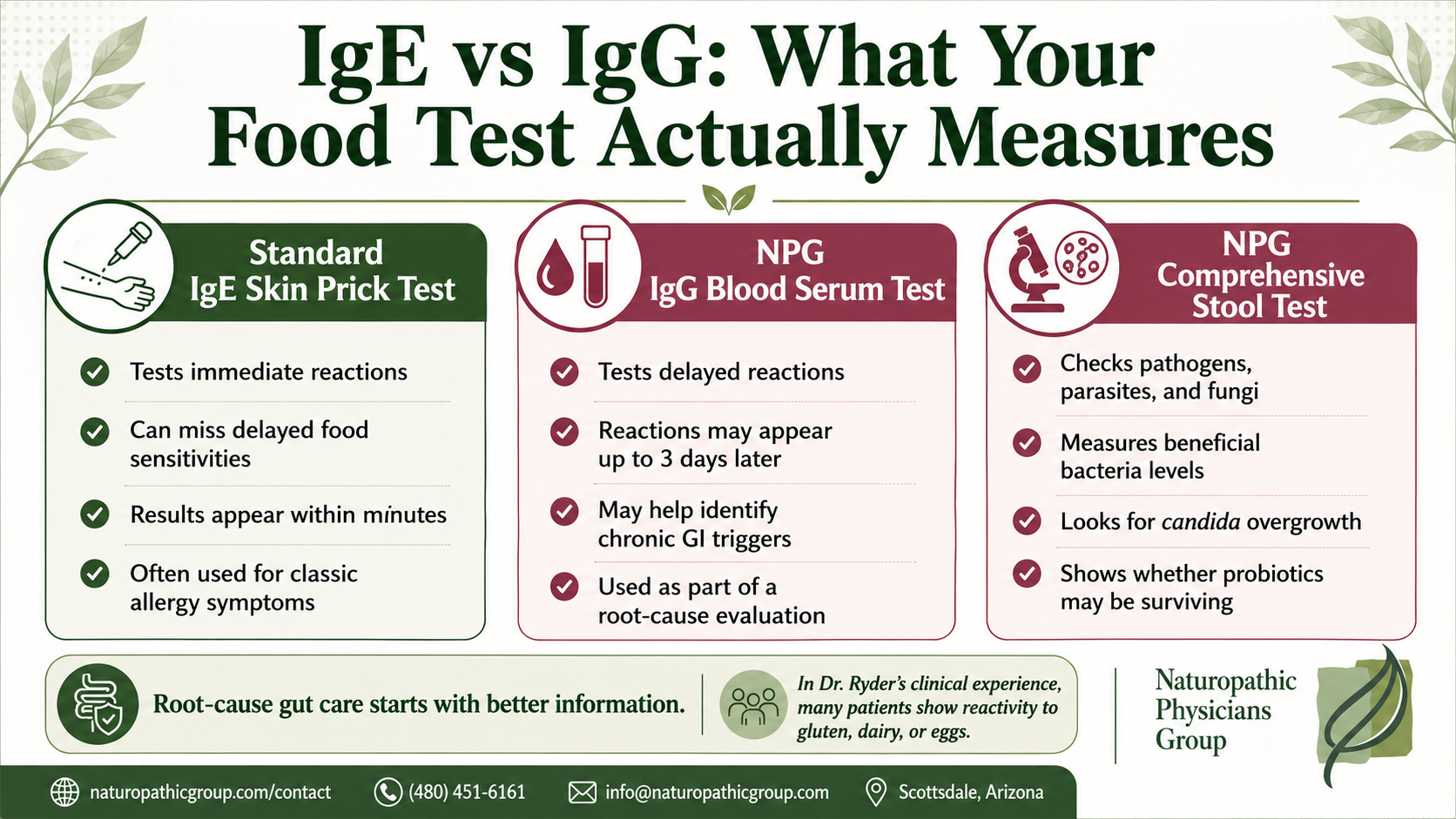
At Naturopathic Physicians Group, we use two primary tests to get a complete picture of what is happening in your gut: IgG blood serum testing and comprehensive stool testing.
IgG blood serum testing is a blood draw that measures your immune system's delayed reaction to dozens of different foods. This is the test that catches the sensitivities that a standard skin prick test misses. When patients get these results back, they are often surprised. Foods they eat every day, sometimes foods they consider healthy, show up as significant reactants. The three foods that appear most often are gluten, dairy, and eggs. In Dr. Ryder's clinical experience, roughly 90% of the food allergy panels she reviews show high reactivity to at least one of these three.
The comprehensive stool test is done at home. We provide a kit, and you return a stool sample in the provided container. What this test reveals goes well beyond what a standard stool test checks for. Your conventional doctor may test for the presence of harmful bacteria or parasites. Our stool test does that, and it also assesses whether you have enough beneficial bacteria in your gut, something conventional stool tests do not measure.
That distinction matters enormously. Many patients are taking probiotics regularly, but have no idea whether those probiotics are actually surviving and replicating in their digestive environment. The stool test can show whether your good flora is depleted, whether a round of antibiotics wiped out your bacterial balance, and whether a fungal overgrowth, such as Candida, may be contributing to your symptoms.
Candida overgrowth is more common than most people realize, and it often goes undiagnosed for years. We have seen cases where Candida was contributing to persistent brain fog, chronic bloating, and fatigue that had been misattributed to other causes for years. The symptoms of candida overlap significantly with food sensitivities, which is one more reason why proper testing rather than guessing is essential.
Together, these two tests give us a real working map of what is happening inside your gut. That map is what allows us to build a targeted, personalized protocol rather than applying a generic template.
This content is for educational purposes only and is not medical advice. Treatment decisions should be made with a qualified healthcare provider who understands your symptoms, history, labs, and goals.
The Three Foods Most Likely Behind Your Symptoms
Based on what we see consistently in clinical practice, if you were going to consider removing any three foods from your diet as a starting point, these would be the three: gluten, dairy, and eggs.
Gluten is the protein found in wheat, and it shows up in bread, pasta, baked goods, sauces, and countless processed foods. Dairy includes milk, cream, cheese, butter, and ice cream. Eggs appear frequently in packaged and prepared foods, even when you would not expect them. All three are classified as inflammatory foods for many patients, which is why they appear so consistently on food allergy panels.
It is worth noting again that gluten-free versions of these foods are not automatically beneficial. A gluten-free cookie is still a cookie. The issue is not just gluten itself but the broader inflammatory response your body may be mounting against these foods. When patients remove gluten, dairy, and eggs after testing confirms a sensitivity, many notice a meaningful improvement in their symptoms within a week.

We want to be clear: this is not a recommendation to eliminate these foods without proper testing first. Removing foods without knowing what your body is actually reacting to can be overly restrictive and difficult to sustain. The goal is to test, understand your specific sensitivities, and build a protocol based on your body's actual data.
How to Eat for Your Gut When You Are Not Sure Where to Start
While testing gives you the specific answers your body needs, there are general eating principles that tend to support gut health across the board. Dr. Ryder offers two practical guidelines that she shares with nearly every patient.
The first is to shop the perimeter of the grocery store. This is where you find produce, refrigerated items, fresh meats, and frozen whole foods. If the food you are holding still looks like what it was when it was growing, it is generally a reasonable choice for your gut. The more processing a food has gone through, the more your body has to contend with what is in it.
The second principle is to eat like a caveman. That means whole foods: things that swim, fly, walk, or grow from the ground or off a tree. Lean meats, vegetables, fruits, and nuts. Foods your body recognizes and knows how to process. Our digestive systems were not built to handle extended ingredient lists full of chemicals and additives.
One practical step you can take right now is to start reading ingredients rather than just nutrition labels. Nutrition labels can be misleading because the calorie and macronutrient estimates are not always precise and do not account for how your specific body processes what is on the label. Ingredients tell a more honest story. If you cannot pronounce what is in a product, or if it has 20 ingredients when the real version of that food has two or three, that is a useful signal. A quality bag of potato chips should have three ingredients. If yours has thirty, you are consuming a product designed more for palatability than health.
These are not radical changes. They are practical, sustainable shifts that, over time, can meaningfully reduce the burden on your digestive system and give your gut the conditions it needs to start healing.
What Healing Your Gut Actually Looks Like
The most important thing to understand about healing your gut is this: the symptoms you have been living with are not normal, no matter how long you have had them. Bloating, gas, constipation, diarrhea, and chronic discomfort are not inevitable features of aging or genetics. They are signals that something in the system needs to be found and addressed.
When you come to Naturopathic Physicians Group for a gut health evaluation, you receive a 60-minute new patient appointment. We go through your complete history, your previous labs if you have them, your symptoms in detail, and your diet. We approach every patient's case as a puzzle, and the diagnostics are one piece of that puzzle. But you can never put the puzzle together without the piece that tells you why this is happening in the first place.
You can learn more about our approach to digestive and GI health at Naturopathic Physicians Group and what that looks like for patients at different stages of their journey. Our goal is not to manage your symptoms indefinitely. Our goal is to find the cause, address it directly, and help your gut heal so that you can travel without worrying about bathrooms, eat a meal without anticipating discomfort, and feel confident in your body again.
This is the first post in our Gut Health Series. As we continue the series, we will be covering acid reflux and GERD, liver health and detox, IV therapy for gut healing, natural approaches to flu and immunity, and the connection between sleep and gut health. Links to each post will be added as they are published.
If you have been told there is nothing more to do, we want you to know there is more to explore. The approach is different here, and so are the results.
Frequently Asked Questions About IBS and Gut Health
What is IBS, and can it actually be treated naturally?
IBS, or irritable bowel syndrome, is a functional GI condition characterized by patterns of constipation, diarrhea, or both, along with bloating and abdominal discomfort. It is one of the most common GI diagnoses, and it is often treated as a permanent condition to be managed rather than a problem with a solvable cause. From a naturopathic perspective, IBS is frequently associated with underlying food sensitivities, bacterial imbalances, or chronic gut inflammation. Identifying and addressing those root causes may lead to meaningful and lasting improvement for many patients, though outcomes vary depending on individual history, labs, and clinical findings.
What is the difference between IgE and IgG food testing?
IgE testing, which includes the standard skin prick test used by most allergists, measures your immune system's immediate reaction to certain foods. These are the reactions that happen within minutes. However, IgE reactions account for only about 15 to 20% of actual food reactions. The majority of food sensitivities are driven by IgG antibodies, which produce delayed reactions that can appear anywhere from a few hours to up to three days after eating the offending food. IgG blood serum testing is what we use at Naturopathic Physicians Group because it captures the delayed reactions that conventional allergy testing misses.
I have had a stool test before, and it came back fine. Why would yours be different?
Standard stool tests run by conventional providers typically look for the presence of pathogenic bacteria, parasites, or viruses. They look for "bad" things. Our comprehensive stool testing also evaluates whether you have enough beneficial bacteria, whether your gut flora has been depleted by antibiotics or other factors, and whether a fungal overgrowth, such as Candida, is present. If your previous test only checked for harmful pathogens, it may have missed the part of the picture that involves your gut's beneficial microbiome, which is often where the problem lies for patients with chronic symptoms.
Do I have to give up gluten, dairy, and eggs forever?
Not necessarily. While some sensitivities, particularly gluten, may warrant long-term avoidance for certain patients, others can be reintroduced gradually once gut healing has taken place. The approach depends on your specific test results, how your body responds to removal, and how your gut recovers over time. The goal is never to restrict indefinitely without reason. It is to give your gut the space to recover and then evaluate what your body can actually tolerate with proper support and monitoring.
Could my gut health be causing symptoms I would not normally connect to digestion?
Yes, and this is one of the most important things to understand about gut health. Because roughly 80% of your immune system is regulated by the GI tract, a gut that is out of balance can contribute to symptoms throughout the body, including chronic skin conditions, recurring infections, sleep difficulties, anxiety, persistent brain fog, and joint pain. If you have unexplained symptoms that have not responded to conventional treatment, a comprehensive gut health evaluation may reveal a connection you have not yet explored.
Ready to take a closer look at what your body is telling you? Dr. Steven Katz and Dr. Loreena Ryder offer personalized, root-cause evaluations for patients who are tired of being told their labs look fine.
Schedule a consultation at naturopathicgroup.com/contact
Phone: (480) 451-6161
Email: [email protected]
Location: Naturopathic Physicians Group, Scottsdale, Arizona
This content is for educational purposes only and is not medical advice. Treatment decisions should be made with a qualified healthcare provider who understands your symptoms, history, labs, and goals.