

Poor Circulation: Signs, Causes, and What We Look For
Your calf tightens on the same walk you take every morning. You stop. It eases. You keep going. Or your feet are cold in a warm room. Or your ankles are puffy by dinner. Or your fingers keep going numb, and you land on the same two words everybody lands on. Poor circulation.
You are probably right. But here is what almost nobody tells you. Circulation goes wrong in two directions, and they are opposites. One of them shouts. The other one says nothing at all for years. Both are dangerous if left untreated.
Key Takeaways
Circulation runs either too fast or too slow. Fast is loud. Slow is silent, and it can go undiagnosed for years.
The system has three parts. Arteries carry blood out, veins carry it back, and the lymphatic system drains your tissues. Everybody forgets the third one.
Cramping, fatigue, numbness, tingling, digestive trouble. All of it sits on the slow list, which is exactly why people blame something else.
The tests are not interchangeable. A quick cuff comparison at your arm and ankle answers a different question than imaging that can clear a blockage on the spot.
Two tests get added here that most workups skip. Heavy metals and food sensitivity. Lead and food-driven inflammation both reach your blood vessels.
Circulation Is Your Body's Transportation System
Circulation is the continuous movement of blood through your body. The heart does the pumping. Problems happen when the flow is either too fast or too slow. Pretty self-explanatory so far.
Here is what your blood is hauling around while it does that. It drops carbon dioxide at the lungs when you exhale and picks up oxygen. It pulls nutrients from the gut and delivers them to your cells. It carries immune cells everywhere they need to go. That is your body's transportation system. Which is why circulation is never really a leg problem. When the transportation breaks down, the deliveries fail everywhere.
The Three Parts That All Have to Work
Arteries carry blood out to your arms and legs. Veins carry it back to the heart for reoxygenation. And then there is the third one, the one that always gets forgotten. Your lymphatic system drains fluid from your tissues.
You need all three to survive. A problem in one can look exactly like a problem in another. That is a big part of why circulation complaints get misread.
When Your Circulation Runs Too Fast
This is the loud one.
High blood pressure. Tachycardia, which just means your heart rate is running high. Arrhythmia, where the rhythm is off. Atrial fibrillation, where the heart isn't pumping properly. Regular old palpitations, that flutter in your chest.
You tend to know something is wrong. And faster is not better. Blood racing through your body is not doing a more efficient job for you. It means something is forcing the system to work harder than it should have to.
When Your Circulation Runs Too Slow
Slow circulation often goes undiagnosed for a very long time. You generally don’t have symptoms until the damage has started. By the time it is obvious, it has been happening for months or years.
The Symptoms That Get Blamed on Something Else
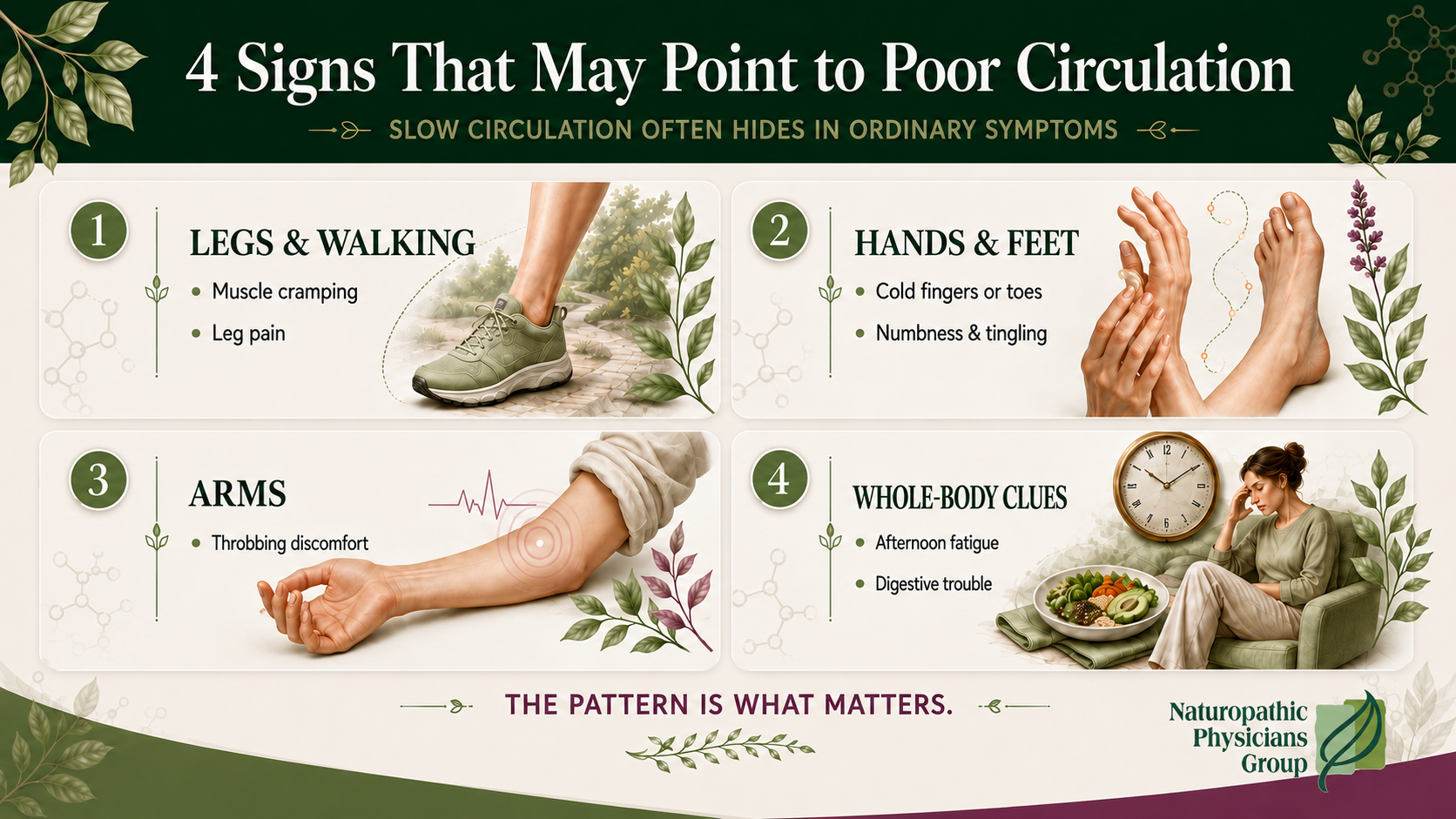
Muscle cramping is the most common one. If blood is stagnating in your legs, you get pain. You get throbbing in your arms. You get fatigued. You get digestive issues, which we end up saying about almost every condition, but it is true here too. And numbness and tingling, because when your muscles are not getting enough oxygen, they start to lose sensation.
Look at that list. Tired legs. A crampy calf. Pins and needles in your foot. Wiped out by three in the afternoon. Bloating after meals. Every one of those has ten explanations that have nothing to do with blood flow. The fatigue alone could be low iron. There is one exception. If a symptom comes on fast, especially with a lot of redness, it could be a clot forming. If you have these symptoms, get it checked immediately.
What Sits Behind Poor Circulation
Peripheral Artery Disease and Atherosclerosis
Peripheral artery disease, PAD for short, is a narrowing or blockage in the vessels that carry blood from your heart to your legs. Peripheral just means the outer tissues. Your arms and your legs.
It's usually caused by atherosclerosis, which is hardening of the arteries. Calcium and fatty deposits build up on the artery walls. The channel gets smaller. Blood has a harder time getting through.
That narrowing can lead to blood clots and to stroke. It can also cause pain, especially when walking.
Atherosclerosis also involves cholesterol, because the same deposit process that narrows an artery in your leg is happening in arteries you cannot see.
Blood Clots
A clot is blood that stopped moving. It is stuck, and the vessel is blocked.
Symptoms come on faster and more sharply than the slow pattern. Real pain. Visible redness. Quick onset.
And if that clot passes, where it goes matters enormously. If it goes to the heart or the lungs, it’s called a pulmonary embolism, or PE for short.
This is a life threatening condition. Call 911 or go immediately to the Emergency Room of your nearest hospital. . That is not a wait and see.
Diabetes and Extra Weight
Diabetes turns up in almost every condition you can name, and circulation is no exception. High blood sugar causes fatty deposits in your blood vessels. Those deposits narrow the vessel. A narrowed vessel does not move blood the way it used to. Simple as that.
If blood sugar has been part of your history, your blood sugar tests may miss what's happening, and follow-up on insulin resistance goes deep on the testing side.
Extra weight causes chronic internal inflammation. Think about your vessels. If inflammation tightens them, you have a harder time pushing blood through, so your circulation suffers. Your body responds by raising your blood pressure, because it still has to get oxygen out to your vital tissues fast enough to keep you alive. So high blood pressure isn't the malfunction. It is a compensatory response.
Inflammation also weakens the vessels, which can lead to aneurysmal disease
Varicose Veins and Raynaud's
People hate varicose veins. Nobody has ever walked in and said, do you love the look of my varicose vein? What they say is, I hate them; they are ugly.
They can be painful, problematic, and can lead to clot formation. Usually, they are a circulation issue that happens to be visible.
Raynaud's is a different thing. Small arteries narrow hard in response to cold or to stress. It hits your fingers and toes. They may turn white, then blue. Raynaud's is very common with autoimmune conditions, so if these symptoms occur, you may have an autoimmune condition.
What the Weather Does to Your Blood Vessels
Did you know the weather outside your body controls the size of your blood vessels?
In warmer weather, your vessels get bigger. The heat opens them up, so blood reaches your vital tissues faster. In colder weather, they narrow, and your blood flow slows down. Live somewhere cold for most of the year, and your circulation is working against that for a good chunk of it.
In Arizona in August, your blood vessels should be running a marathon. There is a real upside to the heat here.
There is also a limit, and the limit is water. Wide open vessels do little if you are dehydrated.
How Circulation Gets Tested
There is no single circulation test. Different questions, different tools.
The Ankle-Brachial Index
This is the simple one. The doctor checks your blood pressure in your arms and ankles, usually with an ultrasound. If there is a difference between those readings, that tells you something about how circulation is doing in your legs.
The exam is quick. It is easy. You are lying down for it. Nothing about it tends to make people nervous.
Duplex Ultrasound
A duplex ultrasound can tell you whether circulation is poor and how severe it is. The severity matters because that is what a vascular specialist uses to decide which treatment options are on the table.
Catheter Angiogram
This is more invasive and works as both a test and a treatment. Dye goes into the affected arteries. An X-ray shows where the blockages are. If they find one, the doctor may open the artery during the same procedure using a device to cut through the plaque.
Doctors usually recommend medications and lifestyle changes before a procedure. These procedures can be complex and are only done by vascular specialists. Because the procedure is invasive, doctors do it only when diagnostic imaging shows a problem and symptoms are life-altering.
The Testing We Add at NPG
Heavy Metals
Heavy metals are one of the factors that can affect the heart. Lead and cadmium are both linked to cardiovascular problems. They contribute to hardening of the arteries and to high blood pressure (hypertension). This is the pattern we often see with patients. Someone comes in concerned about their blood pressure. Their doctor recommended different medications, and the number is still high. That is the point where we check heavy metals, and high levels of lead are often what we see.
Food Sensitivity Testing
Your blood vessels are part of your body. If you have inflammation, your vessels are inflamed too, and that feeds hypertension.
That is why food sensitivity testing is part of the diagnosis. The point is not to give you a long list of foods you can’t eat. Rather, it helps you find foods you can enjoy that don’t cause inflammation and moderate those that do.

What Conventional Treatment Looks Like
Compression and Elevation
Compression socks are the familiar one. If circulation is poor down your legs, you compress the lower limbs and push the blood upward. Leg elevation does the same job with gravity, moving blood back toward your heart and lungs.
If you have leg swelling after standing for periods of time or consistently at the end of the day, compression socks can be helpful. They come in lots of different sizes, colors, and compression ratings. Choose ones that work for your lifestyle.
Venous and lymphatic flow from the legs is largely governed by the calf muscles. Doing toe raises while sitting or calf raises while standing can assist venous return. Regular walking also helps strengthen the calf muscles and the heart. Both improve blood flow and reduce swelling.
Elevating your legs when possible during the day and at night can also help reduce swelling. Ironically, drinking more water can help with venous circulation. Dehydration reduces overall blood volume and lessens blood flow from the legs.
Procedures
Because cardiovascular disease is progressive, meaning that it gets worse with time, there are a number of procedures that vascular specialists can perform when the symptoms become life altering. If you suspect that you may have symptoms of cardiovascular disease, ask your physician for a referral to a specialist.
Medications
Statins reduce cholesterol when plaque and fat deposits in the vessels are the issue. Antiplatelet drugs like Plavix and aspirin reduce the likelihood of clotting. Blood thinners like warfarin or Eliquis reduce the risk of venous clots.
Over-the-counter drugs like aspirin and ibuprofen are not without potential side effects. Heavy aspirin use has been linked to stomach ulcers. Aspirin and ibuprofen have both been linked to tinnitus, the ringing in the ears, as an infrequent complication.
If your doctor has prescribed any of these medications, do not stop taking them without consulting them first. The information presented here is for educational purposes only. It is meant to inform you about your health and how to help you ask better questions with your physician.
Where Circulation Shows Up That People Never Expect
Hemorrhoids.
A hemorrhoid is an inflamed blood vessel. So if you are a chronic hemorrhoid sufferer, it could be a deeper issue with the integrity of your blood vessels generally, and that is just where it showed up.
Conventional treatment for hemorrhoids is usually a blood pressure medication in a topical cream. You rub it on; it slows blood flow, and the vessel heals. On the naturopathic side, when somebody has hemorrhoids and high blood pressure both, treating the blood pressure often clears up the hemorrhoids right along with it.
The Foundation Underneath All of It
The lifestyle piece is obvious, and it does most of the work.
Food. If you eat lots of fried foods, sweets, and junk food, your circulation will be poor. That is not a judgment; it is mechanics. Obesity, peripheral artery disease, and diabetes all link back heavily to what you are eating.
Movement. When you exercise, you get those vessels pumping. You dilate them. You open them up, and you get better blood flow. That is the whole mechanism.
Smoking. Smoking tightens the vessels. The smoke contains heavy metals. It is inflammatory, and it's strongly linked to blood clotting. Quitting is easier said than done. But if you have circulatory issues and you continue smoking, you are compounding the problem.
Water. Oxygen and water. Almost everything downstream works better when those two are handled.
There is a visible piece to this too, and people notice it before they notice anything else. Blood flow reaches your face when you exercise. That is where the post workout glow comes from, the pink in the cheeks. It does not have to be a gym. Kayaking gets you there. Dancing gets you there. A jog outside gets you there. Physical movement that actually raises your effort is what does it.
The Foods That Keep Coming Up
One thing first, because it frames the whole list. We are not telling you to start or stop anything. We are telling you what the research says and what we see. Anything you change should be discussed with your doctor. And if you do not have a good one, we happen to know a few.
Arugula. It contains nitrates, and several studies have shown dietary nitrate improves oxygen delivery and utilization. It also beats plain old lettuce on flavor.
Beets. Nitric oxide again, and nitric oxide dilates the vessels. Look at almost any natural blood pressure formula on the shelf, and there are beets in it. That is not an accident. One heads up so it does not scare you. Beets can turn your urine reddish. If beets have been on the menu lately, that is usually your answer.
Garlic and onions. Linked to cholesterol regulation, blood pressure, and protection against cell damage.
Berries. Blueberries, strawberries, raspberries. The antioxidants are seriously anti-inflammatory. Berries also relax the blood vessels, and when the vessels relax, the flow improves.
Citrus. The flavonoids in citrus act as vasorelaxants, which keep your vascular system toned. Strong, healthy veins support good circulation, which is the point.
Leafy greens. They help oxygen circulate more efficiently and support the integrity of your vessels.
Rosemary. Rosemary is warming, and warming the body improves circulation. It has been used historically for exactly this.
Tea. Green and black tea both enhance circulation and protect blood vessels, as long as you aren't dumping sugar and creamer in. Green tea carries more antioxidants of the two. Ginger tea is a vasodilator, which opens the vessels and lets blood move better. If it is a healthy tea, it is very likely good for your circulation. And if the caffeine side of that is on your mind, what coffee does to your metabolism covers it.
Pomegranate. Rich in antioxidants. It opens and relaxes blood vessels, which is how it affects blood pressure.
Now here is the one nobody puts on the list. Unhealthy food. Look back at everything above. Every single one is normally healthy food. That is not a coincidence.
Trans fats are the clearest offenders, meaning hydrogenated and partially hydrogenated oils. They live in the boxed aisle. Cookies, crackers, chips, frozen pizza, microwave popcorn.
The Supplements That Come Up Most
Our position on supplements first, because it is probably not the one you are expecting.
We are not telling anybody to go out and buy a bunch of things. We actually hate it when someone shows up with forty supplements and has no idea why they are taking any of them. That is a waste of money and a waste of the opportunity. The point is that knowing what you are doing matters. And when somebody cannot answer why a bottle is in the cabinet, that answer usually comes from sitting down with someone who can.
With that said, here is what comes up.
Citrulline converts into arginine, an amino acid that produces nitric oxide. Studies have shown citrulline is more effective than taking arginine directly for relaxing blood vessels and improving blood flow.
Fish oil, or flaxseed oil on the vegan side, for those omega-3 fatty acids. Major anti-inflammatory properties. It helps with blood pressure. It helps with blood flow. Great for brain health. You name it, fish oil is generally good for it. Unless you are on blood thinners, in which case it may not be, because both affect clotting. That is a combination we always want to know about.
Diosmin is a citrus flavonoid in supplement form. It improves lymphatic drainage and supports microcirculation, which matters because your vessels get tiny out at the fingers and toes. We love this stuff for venous insufficiency. It is one of our go-tos when someone is really struggling.
Gotu kola turns up in a lot of brain health supplements, and circulation is the reason. Think about it. Better blood flow to the brain means you have to open up those vessels. Gotu kola works on flow to the periphery, your arms and your legs, and to the brain. So it is good for memory, good for focus, and good for circulation all at once.
Ginkgo biloba had its trendy moment. You could buy ginkgo shots at a convenience store. The flavonoids in ginkgo protect the blood vessels and arteries, which makes it as much a preventative as anything.
Capsaicin comes from cayenne pepper, and it is warming. Warming improves blood flow. There is an over-the- counter capsaicin cream people use for joint pain. You put it on, it warms the area, and the pain comes down.
When oral supplementation cannot get a dose where it needs to go, some of what we do runs through IV therapies instead. That is a clinical decision built on testing, not something off a menu.
This content is for educational purposes only and is not medical advice. Treatment decisions, including any change to supplements or medications, should be made with a qualified healthcare provider who understands your symptoms, history, labs, medications, and goals.
What Brings People Into Our Office
You do not need a diagnosis before you start asking better questions.
Here is what we hear most. Leg pain that shows up when you walk. One foot colder than the other. Ankles that swell by evening. Tingling that keeps coming back. Blood pressure that three medications have not moved.
And here is the idea underneath all of it. If you have chronic issues, it is very likely you have circulation issues too. They travel together. That is what a whole-health assessment is built for. So when circulation is the reason someone calls, we are also looking at metabolic and digestive health, at blood sugar, at inflammation, at what you are eating, at your medications, and at what has already been tested.
We do not have time to go through every single thing out there for circulation. But the short version is this. If it is healthy for you and it is not crap, it is probably good for your circulation. And if you have chronic issues, it is very likely circulation is one of them.
Frequently Asked Questions
What causes poor circulation?
Poor circulation is a description rather than a single diagnosis, and several conditions sit behind it. Peripheral artery disease narrows the arteries carrying blood to your limbs, usually through atherosclerosis. Blood clots block a vessel outright. Diabetes creates fatty deposits that narrow vessels over time. Excess weight drives inflammation that tightens and weakens vessel walls. Varicose veins and Raynaud's each produce their own pattern.
What are the symptoms of poor circulation?
When circulation runs slow, common symptoms include muscle cramping, leg pain, throbbing in the arms, fatigue, digestive trouble, and numbness or tingling as tissue stops receiving enough oxygen. When circulation runs fast, symptoms are more obvious and include high blood pressure, an elevated heart rate, an irregular rhythm, and palpitations. The slow version tends to go unrecognized for years.
How is circulation tested?
An ankle-brachial index compares blood pressure at your arm and your ankle, and it is quick, painless, and commonly done in-office. A duplex ultrasound can establish whether circulation is poor and how severe the problem is. A catheter angiogram is more invasive, uses dye and X-ray to locate blockages, and can sometimes clear a blockage during the same procedure. At NPG, we also include heavy metal and food sensitivity testing in our workup.
Why are my hands and feet always cold?
Cold fingers and toes can reflect several things. Temperature itself narrows the small vessels near your skin, which is normal. Raynaud's is a more pronounced version, where small arteries narrow sharply with cold or stress and the skin may turn white and then blue. Raynaud's appears very commonly alongside autoimmune conditions. Slow circulation generally can also leave extremities colder than the rest of the body.
Can food improve circulation?
Food comes up constantly in circulation conversations because so much of what narrows and inflames blood vessels traces back to diet. Nitrate-rich foods like arugula and beets relate to nitric oxide, which dilates vessels. Berries, citrus, leafy greens, tea, and pomegranate all connect to vessel relaxation and antioxidant activity. Trans fats work in the opposite direction. None of this replaces evaluation or prescribed treatment, and any change belongs in a conversation with your doctor.
Take the Next Step
Ready to take a closer look at what your body is telling you? Dr. Steven Katz and Dr. Loreena Ryder offer personalized, root-cause evaluations for patients who are tired of being told their labs look fine.
Schedule a consultation at naturopathicgroup.com/contact
Phone: (480) 451-6161
Email: [email protected]
Location: Naturopathic Physicians Group, Scottsdale, Arizona
This content is for educational purposes only and is not medical advice. Make treatment decisions with a qualified healthcare provider who understands your symptoms, history, labs, and goals.