
Fatty Liver: Causes, Warning Signs, and Natural Support
Fatty liver is the most common liver disease in the country and one of the easiest to miss. It often builds quietly, with few or no symptoms, until it shows up on a lab result or starts dragging down your energy. The frustrating part is that many people are told their liver is "fine" while they still feel tired, sluggish, and not quite themselves.
If that sounds familiar, you are not imagining it. At Naturopathic Physicians Group in Scottsdale, Dr. Steven Katz and Dr. Loreena Ryder take the time to look at the whole picture, find the root cause, and support your body's natural ability to heal. Your liver is one of the most regenerative organs you have, and there is a lot you can do to help it.
Why Fatty Liver Is So Common and So Easy to Miss
Your liver is one of your body's primary detox organs. It sits in the upper right area of your abdomen, just under your rib cage, and it is roughly the size of your two hands placed together. It handles hundreds of jobs every day. When fat builds up inside it, all of that work slows down, and the effects can ripple through your whole body.
Key Takeaways
Fatty liver is the most common liver disease, and excess sugar is a leading cause.
Even people who say they do not eat sugar can develop it, since carbohydrates convert to glucose in the body.
A fat-laden liver detoxes more slowly, which can raise your toxic burden over time.
Common warning signs include fatigue, upper right abdominal pain, itchy skin, and yellowing of the skin or eyes.
The liver is highly regenerative, and diet, exercise, hydration, and targeted support can help it recover.
What Your Liver Does, and Why Fat Slows It Down
Dr. Ryder describes the liver as responsible for at least 500 different reactions in the body. Here is some of what it handles every day:
Processes hormones, medications, and cholesterol
Manages glucose, or blood sugar, to produce and store energy
Processes iron and supports blood clotting
Produces proteins and supports your immune system
Helps you absorb nutrients and produces bile to aid digestion
Stores vitamins like A, D, E, K, and B12, then converts them into the active forms your body can use
Filters harmful bacteria out of your blood
Here is a detail most people miss. Your liver produces around 80 percent of the cholesterol in your body, and that is not a bad thing. Your body needs cholesterol to make hormones. As Dr. Katz explains, this is one reason cholesterol-lowering medications can come with side effects like low testosterone, low sex hormones, and fatigue. When that much depends on a healthy liver, it makes sense that a fatty, sluggish liver can leave you feeling off in ways that are hard to pin down.
The Sugar Connection Behind Fatty Liver
This is the part Dr. Katz says your conventional doctor may not have time to explain. Your liver converts excess sugar into fat. So when your diet is high in sugar, you are not only creating inflammation, but you are also adding fat to your liver. Over time, that leads to chronic fatty liver.
And it is not just the obvious sugar. Dr. Ryder points out that refined, highly processed foods, the kind that come in a box and sit on a shelf, turn into sugar in your bloodstream after you eat them. Even if you think you do not eat much sugar, the carbohydrates in processed food convert to glucose, and your body treats it the same way.
Why does this matter so much? Because your liver is a detox organ. When it becomes fatty and sluggish, your whole detox system slows down. As Dr. Katz describes it, if you take in more toxins each day than your liver can clear, the leftover builds up. A little each day becomes a lot over a year, and a real burden over a decade. That growing toxic load is linked to inflammation and other chronic conditions.
Warning Signs Your Liver May Be Struggling
Liver conditions often share similar symptoms, and many people have no symptoms until a later stage. Here are the most common signs that doctors describe:
Upper right abdominal pain. Often, the first sign is felt just under the right rib cage.
Fatigue. Ongoing, unexplained tiredness.
Yellowing of the skin or eyes. Known as jaundice, this condition means your body is having trouble clearing bilirubin. It is often subtle, not the bright yellow shown in movies. If you notice it, see a doctor right away.
Itchy skin. Another sign of bilirubin building up.
Dark urine.
Nausea or vomiting.
Swelling in the arms and legs. Fluid buildup can signal liver disease. In the abdomen, this fluid is called ascites.
Loss of appetite.
Alcoholic vs Non-Alcoholic Fatty Liver
There are two main types of fatty liver, and the difference matters.
Non-alcoholic fatty liver disease is the most common. It comes from a diet high in refined, processed foods and added sugar. Dr. Ryder notes that even people who say they do not eat sugar can develop it, because carbohydrates convert to glucose in the body.
Alcoholic fatty liver disease is caused by drinking. The sugar content in alcohol inflames the liver, and over time this can progress to cirrhosis, which is chronic scarring that can lead to liver failure. The liver is remarkably regenerative, but as Dr. Katz notes, it does have a point of no return, which is why earlier action is always better.
Fatty liver is not the only thing that can affect this organ. There are also viral conditions like hepatitis A, B, and C. For a broader walk-through of how the liver detoxifies and the full range of liver conditions, read our companion post on liver detox.
How Fatty Liver Is Tested
The good news is that checking your liver does not require anything exotic. Most of it shows up on standard testing.
Comprehensive Metabolic Panel (CMP). This common blood panel, often run at your annual physical, includes a full liver function test. It measures markers like AST, ALT, GGT, ALP, bilirubin, and albumin. When something is wrong, these tend to arise.
What the numbers suggest. Dr. Katz explains that with fatty liver, enzymes are often one to two times above the normal range. With hepatitis, late-stage conditions, or liver cancer, they can climb much higher.
Abdominal ultrasound. Dr. Ryder calls this the first-line imaging for the liver. It uses no radiation and can also check nearby organs like the gallbladder and kidneys.
FibroScan. A specialized ultrasound that measures the degree of scarring and fat in the liver.
Physical exam. A doctor can often feel the liver by palpating under the rib cage to check for pain or enlargement.
The doctors recommend liver tests as part of routine yearly labs, or twice a year if there is a specific concern.
Medications That Can Add to the Load
Because the liver processes most of what you put in your body, certain medications can stress it over time. Dr. Katz lists several common ones to be aware of:
Acetaminophen (Tylenol), the most common over-the-counter example
Certain antibiotics
Gout medications like allopurinol
Statin (cholesterol) drugs
Some arthritis and antipsychotic medications
Certain painkillers, such as diclofenac, an NSAID
If you take any of these regularly, it is worth checking your liver enzymes more often. Talk with your doctor about the right schedule for you.
Natural Ways to Support and Reverse Fatty Liver
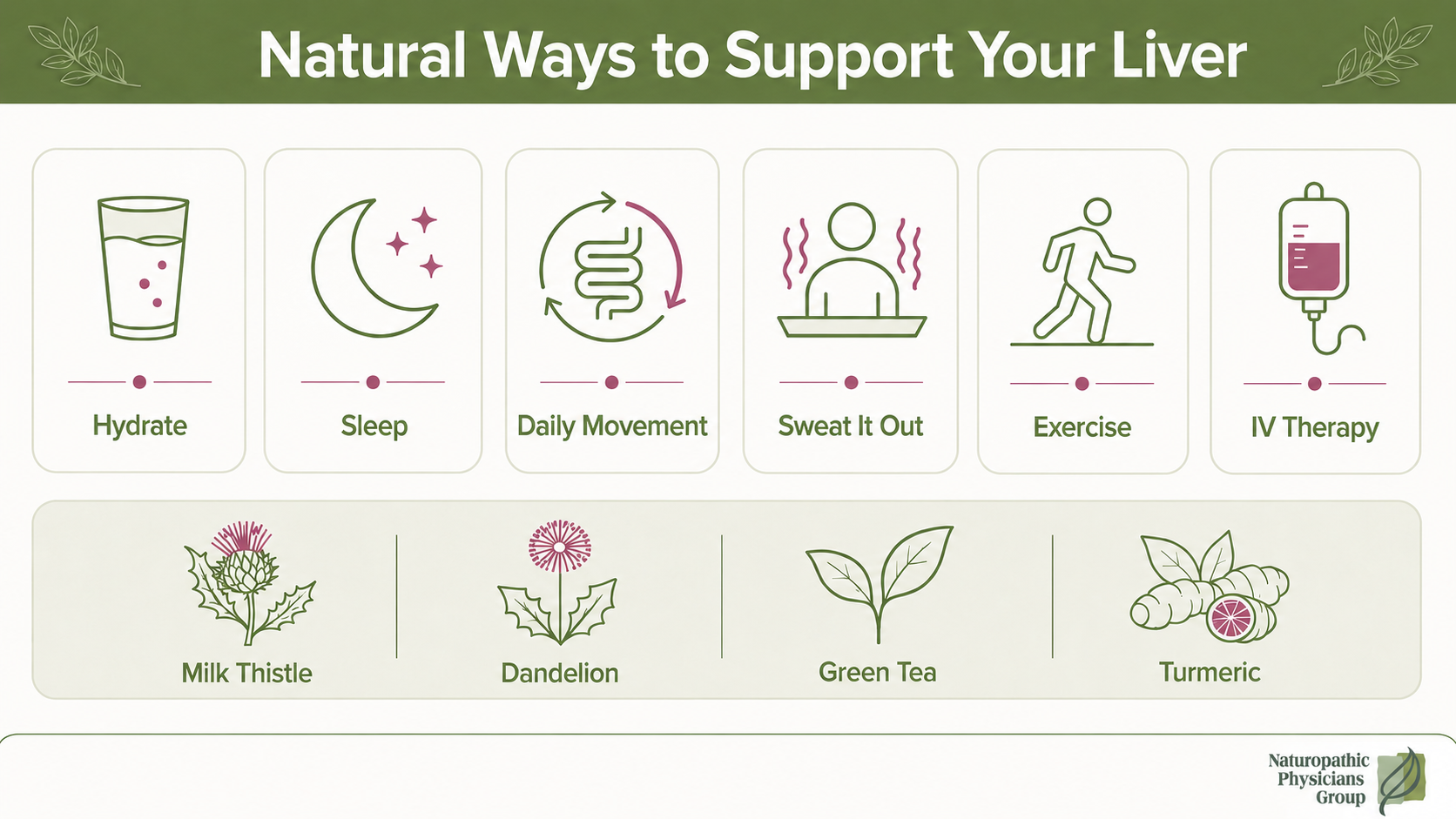
This is where naturopathic medicine shines. The goal is to support all of your body's detox pathways so your liver is not carrying the full load. Here is what Dr. Katz and Dr. Ryder recommend.
Drink enough water. Water helps flush toxins out. The doctors' rule of thumb is to drink at least half your ideal body weight in ounces each day.
Prioritize sleep. Your body regenerates and cleans house while you sleep. Quantity and quality both matter, and the right amount is different for everyone.
Have a daily bowel movement. This is one of your main detox pathways. The doctors are clear that "regular" means daily, ideally more than once a day. If you are not eliminating waste daily, you are not detoxing as well as you could be.
Sweat. Sweating clears toxins through the skin, your largest organ. Aim for exercise that actually gets you sweating. An infrared sauna is another option, and the doctors note it can clear toxins at a higher rate than a traditional sauna.
Exercise consistently. Dr. Ryder suggests around five days a week, at least 30 minutes a day. This can help reverse and remove fatty liver, boost energy, and improve oxygen flow to your organs.
Do not undo your progress. Dr. Katz puts it plainly. Do not "rob Peter to pay Paul" by detoxing and then loading up on alcohol and sugar. Real healing comes from consistency, not from canceling out good habits with bad ones.
Consider IV therapy. IV nutrients bypass the digestive tract and reach your bloodstream directly. NPG's popular Myers' Cocktail delivers vitamin C and other nutrients, often followed by glutathione, a powerful antioxidant that goes right to work supporting the liver.
Castor oil packs at home. Dr. Ryder shares a classic naturopathic tip. Used topically, never taken by mouth, castor oil can be applied over the liver area on the lower right rib cage. The simple version is to rub it on the skin, cover with an old shirt, and let it absorb overnight. The more involved version uses a cloth soaked in castor oil with a heating pad over the area for about 20 minutes. Castor oil comes from the castor bean. Its therapeutic component is ricinoleic acid, which is anti-inflammatory and supports detox through the lymphatic system.
Targeted supplements. Several herbs have a long history of liver support:
Milk thistle. The most well-known. Used for thousands of years, it acts as an antioxidant, lowers liver inflammation, and has been shown to slow the progression of liver damage.
Dandelion. Supports the liver and helps produce bile.
Burdock root, red clover, and ginseng. Studies suggest these can help lower elevated liver enzymes.
Green tea. Anti-inflammatory, and shown to lower ALT and AST and support fatty liver. Skip the added sugar.
Turmeric. A doctor's favorite, good for the liver, brain, and heart.
One important note from the doctors. Do not run out and self-dose these. The right supplement and the right dose depend on your individual case, which is exactly what a consultation is for.
How NPG Approaches Liver Health
At Naturopathic Physicians Group, your visit looks different from a rushed conventional appointment. Your first visit is a full hour, with a thorough intake and many questions, because the goal is to find the root cause and treat that, not just chase symptoms. Whether the answer is diet, targeted lab work, IV therapy, or a personalized supplement plan, Dr. Katz and Dr. Ryder build it around you.
If you feel like your health has been more of a struggle than it should be, it may be time for a different approach.
Frequently Asked Questions
What causes fatty liver? The most common cause is a diet high in sugar and refined, processed foods. Your liver converts excess sugar into fat, and processed carbohydrates convert to glucose in the body, so even people who do not think they eat much sugar can develop it. Alcohol is the other major cause.
What are the warning signs of fatty liver? The most common first sign is pain in the upper right abdomen, under the rib cage. Other signs include fatigue, yellowing of the skin or eyes, itchy skin, dark urine, nausea, swelling in the arms and legs, and loss of appetite. Many people have no symptoms until a later stage, which is why routine testing matters.
How is fatty liver tested? A standard blood panel called the Comprehensive Metabolic Panel includes liver function markers like AST, ALT, GGT, and bilirubin. With fatty liver, these are often one to two times above the normal range. Imaging, such as an abdominal ultrasound or a FibroScan, can show fat and scarring directly.
Can fatty liver be reversed? The liver is highly regenerative and can recover with the right support, especially in the early stages. Diet changes, regular exercise, hydration, and supporting your other detox pathways all help. Advanced scarring, called cirrhosis, is much harder to reverse, so earlier action is better.
What natural remedies support the liver? The doctors point to water, quality sleep, daily bowel movements, sweating and infrared sauna, regular exercise, IV therapy like the Myers' Cocktail with glutathione, and supplements such as milk thistle, dandelion, green tea, and turmeric. A doctor should guide dosing.
Which medications can affect the liver? Common ones include acetaminophen (Tylenol), certain antibiotics, gout medications like allopurinol, statins, some arthritis and antipsychotic medications, and certain NSAIDs like diclofenac. If you take these regularly, ask your doctor about checking your liver enzymes.
Ready to Get Real Answers About Your Liver?
You do not have to wait for a lab result to take your liver health seriously. Dr. Steven Katz and Dr. Loreena Ryder at Naturopathic Physicians Group in Scottsdale offer both in-office and virtual consultations, and they take the time to find out why your body is not working the way it should.
Schedule a consultation today: https://naturopathicgroup.com/contact
Naturopathic Physicians Group
9200 E. Raintree Dr., Suite 150, Scottsdale, AZ 85260
Phone: 480-451-6161
This content is for educational purposes only and is not medical advice. Treatment decisions should be made with a qualified healthcare provider who understands your symptoms, history, labs, and goals.