Regenerative Medicine: The Future of Arthritis Treatment Is Here
You have been told your arthritis is permanent. That it is wear and tear. That your only options are pain pills, injections, or eventually surgery. If you have felt dismissed, discouraged, or quietly fearful about what the next decade will look like for your joints, you are not alone.
At Naturopathic Physicians Group in Scottsdale, Arizona, we see this every day. We provide regenerative medicine consultations for patients throughout Scottsdale, Phoenix, and surrounding Arizona communities. Patients walk into our office believing their body is breaking down. They have tried anti-inflammatories. Some have tried cortisone shots. A few have already scheduled surgery consultations. And most of them were never told there is another path. There is.
Regenerative medicine is changing how we think about arthritis. Not as something to suppress. Not as something to replace. But as something that can often be stabilized and improved by working with your body's own biology.
What Is Arthritis, Really?
Arthritis is not one condition. It is a category, and understanding which type you have is the first step toward choosing the right treatment. Osteoarthritis is the most common form. It is typically described as wear and tear arthritis and often affects the knees, hips, hands, and shoulders. It progresses gradually and is associated with cartilage thinning and joint space narrowing.
Rheumatoid arthritis is autoimmune. It is inflammatory, systemic, and can affect multiple organs.
Gout is caused by uric acid crystal buildup and produces sudden, severe joint pain.
Psoriatic arthritis links skin patches with joint damage.
Most patients are told simply, "You have arthritis," without understanding which type, what stage, or why it developed. And that matters. Because when you do not understand the mechanism, you cannot choose the right treatment.
Why Does Conventional Arthritis Treatment Focus on Suppression?
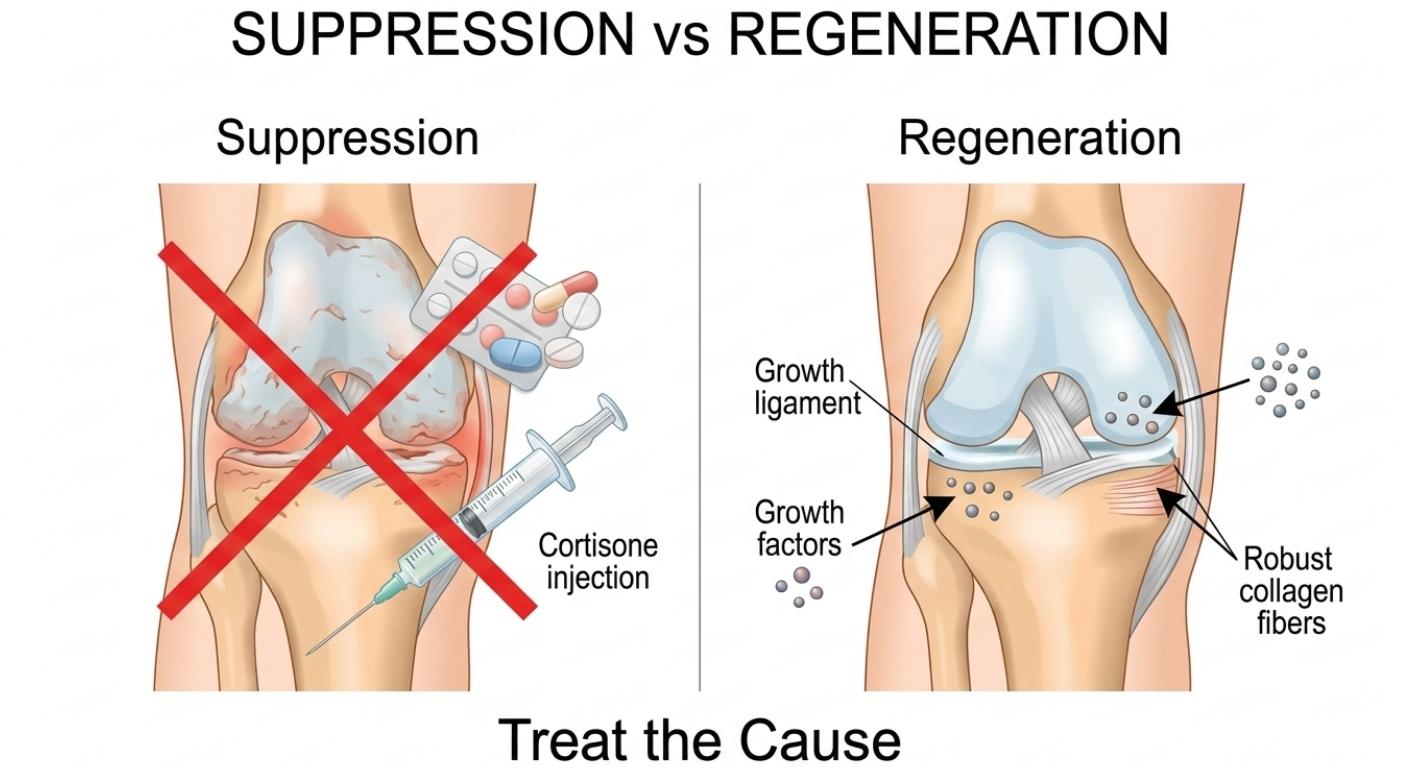
Conventional medicine is built around symptom control. Painkillers reduce discomfort. NSAIDs reduce inflammation. Steroids suppress the immune response. Surgery replaces the joint altogether. The problem is not that these tools exist. The problem is that none of them repair tissue.
Anti-inflammatories block the inflammatory pathway your immune system uses as a signal for healing. Cortisone injections suppress collagen production. Repeated steroid use weakens ligaments and tendons over time. This is why relief often becomes shorter with each injection and why patients increase medication doses as the months and years pass. The joint continues to degenerate despite symptom control. Suppression is not the same as restoration.
Do MRIs Tell the Whole Story?
One of the biggest mistakes we see is over-reliance on imaging. MRIs and X-rays show damage. They show cartilage thinning, bone spurs, and joint space narrowing. But there is something critical that they cannot show, and that is instability.
Many cases of chronic joint pain are actually driven by ligament weakness and instability. Ligaments hold joints in proper alignment. When they weaken, micro-movement occurs inside the joint. That instability increases stress on the cartilage. In other words, cartilage breakdown may be the effect of ligament weakness, not the original cause. An MRI cannot measure ligament strength, which is exactly why a proper physical examination matters so much.
In our Scottsdale clinic, we combine imaging review with hands-on orthopedic assessment. We test joint stability. We palpate supportive structures. We evaluate movement patterns. We treat the patient, not just the scan.
What Is Regenerative Medicine?
Regenerative medicine focuses on stimulating the body's own healing mechanisms. Instead of blocking inflammation, we trigger controlled healing responses. Instead of suppressing immune signaling, we enhance it in targeted areas. Instead of replacing joints, we strengthen the structures that support them. The goal is stability, improved function, and tissue repair.
At Naturopathic Physicians Group, our regenerative protocols include prolotherapy, Platelet-Rich Plasma (PRP) therapy, Xcell therapy, and Focused shockwave therapy. Each has a specific role depending on the severity of the condition and the type of tissue involved.
How Does Prolotherapy Work?
Prolotherapy is one of the oldest regenerative injection therapies available. It uses a solution of medical-grade dextrose combined with supportive nutrients, which is injected into weakened ligaments and joint attachments. The dextrose creates a controlled inflammatory signal that tells your immune system repair is needed in that specific area. The body responds with increased blood flow, fibroblast activity, and collagen production.
Over a series of treatments, ligament strength improves, stability improves, and pain decreases. This is not suppression. This is stimulation of your body's own healing capacity, directed precisely where it is needed.
What Is PRP Therapy for Pain?
PRP stands for Platelet-Rich Plasma. We draw a small amount of your blood and spin it in a centrifuge to concentrate the platelets. Platelets contain growth factors that direct tissue repair. We then inject that concentrated healing solution directly into the joint or its supporting structures.
PRP is stronger than prolotherapy and is especially helpful in cases of osteoarthritis, tendon degeneration, partial tears, and long-standing injuries. It accelerates healing in areas where the body has stalled on its own.
Can PRP Help Knee Arthritis?
PRP for knee arthritis is one of the most researched regenerative treatments available today. Knee joints bear significant weight, and when cartilage thins and ligaments loosen, instability develops quickly. PRP can improve joint lubrication, stimulate cartilage-supportive cells, strengthen surrounding connective tissue, and reduce inflammatory cytokines without blocking the healing process.
Many patients seeking PRP for knee arthritis in Scottsdale are trying to avoid knee replacement surgery. While PRP does not grow back a brand-new joint, it can significantly improve function, reduce pain, and delay surgical intervention in appropriate candidates. Patient selection, severity of degeneration, and technique all matter in determining outcomes.

What Is Xcell therapy?
Xcell therapy is a more concentrated version of platelet therapy that allows us to achieve higher platelet density with fewer blood draws. It can be particularly beneficial for patients with advanced degeneration or those seeking fewer treatment sessions. The higher concentration produces a stronger regenerative response and represents the personalized approach we apply to every patient. This is not one-size-fits-all medicine.
What About Focused Shockwave Therapy?
Not every patient wants injections, and Focused shockwave therapy offers a non-invasive alternative that uses acoustic waves to stimulate healing in soft tissue. It increases circulation, activates cellular repair pathways, and improves collagen remodeling. Shockwave can be used alone in mild cases or alongside injections in more complex presentations, giving us a flexible tool for patients at different stages of joint degeneration.
What Supplements Support Joint Regeneration?
Regeneration is not only external. Internal support matters significantly as well. Type 2 collagen supports cartilage structure. Curcumin modulates excessive inflammation without shutting down the healing process. Glucosamine and chondroitin provide structural building blocks for joint tissue. High-quality fish oil supports proper omega balance which aids in healing, and vitamin C is essential for collagen synthesis.
Weight management reduces compressive load on joints, and consistent movement maintains lubrication. These are valuable adjuncts to care, but they are not replacements for structural repair when instability exists and needs to be addressed directly.
The discussion of these therapies is for educational purposes only. Please consult a medical professional who knows your personal history before starting any new therapies.
What Happens If Arthritis Is Left Untreated?
When arthritis is suppressed without addressing the underlying instability, degeneration typically continues to progress. Over time, patients often experience increased medication dependency, reduced mobility, muscle weakness, weight gain, sleep disturbance, and eventually surgical escalation. If you have been treated with steroid injections, they can weaken connective tissue further, and each treatment will continue the instability and accelerate the cartilage stress.
Decline is not inevitable. But unmanaged instability absolutely accelerates it. The longer you wait, the narrower the joint space becomes, and the more complex the treatment becomes.
What Does Life Look Like After Regenerative Care?
When instability improves through regenerative care, patients often describe a noticeable shift in their daily experience. Morning stiffness decreases. Walking feels smoother. Stairs become manageable again. Patients return to activities they had quietly given up. Many report improved sleep because they are no longer waking from pain throughout the night.
The goal is not perfection. The goal is functional restoration and pain free. We have seen patients in their 50s, 60s, and 70s regain mobility they believed was gone for good, not through replacement of joints, but through reinforcement of the structures that support them.
The Cost of Waiting
Every month spent suppressing symptoms without addressing instability is a month of continued cartilage stress. Ligaments that remain weak allow micro-movement to persist. That micro-movement keeps eroding joint space. The window for regenerative intervention narrows as degeneration advances.
The earlier regenerative stabilization begins, the better the outcomes tend to be. Severe bone-on-bone degeneration may still require orthopedic intervention, but many patients have successfully delayed or avoided surgery entirely with the right regenerative approach applied at the right time.
Take the Next Step Toward Restoration
If you are searching for surgery free regenerative medicine for arthritis in Arizona, we invite you to schedule a comprehensive evaluation with Dr. Steven Katz and Dr. Loreena Ryder at Naturopathic Physicians Group. A comprehensive regenerative evaluation can determine whether your joint is a candidate for stabilization before surgery becomes the only option. Your body is not broken. It may simply need the right stimulus to begin healing again.
Schedule your consultation at naturopathicgroup.com/contact
Phone: (480) 451-6161
Email: [email protected]
Location: Naturopathic Physicians Group, Scottsdale, Arizona