
Can IV Therapy Help When Your Gut Can't Absorb Nutrients?
You do everything right. You take your supplements, you try to eat clean, and you drink your water. And still, you feel depleted, foggy, and slow to recover. If you also live with a sensitive stomach, bloating, or a digestive condition, that frustration runs even deeper because you are putting good things into your body and getting very little back.
Here is the piece most people are never told. Swallowing a nutrient does not mean your body actually uses it. When your gut is inflamed or irritated, much of what you take by mouth can pass right through you. The problem may not be your effort or even your supplements. The problem may be absorption. And that single shift in understanding is what brings many digestive patients to IV therapy.
Key Takeaways
When your gut is inflamed or sluggish, oral supplements may not be absorbed, no matter how good they are.
IV therapy bypasses the digestive tract and delivers nutrients straight into your bloodstream.
For gut patients, IV therapy can support energy and recovery while the deeper digestive issue is addressed.
Naturopathic Physicians Group offers several IV types, each suited to different needs, always after testing.
IV therapy is one part of a whole-body plan, not a stand-alone fix.
When Your Gut Becomes the Bottleneck
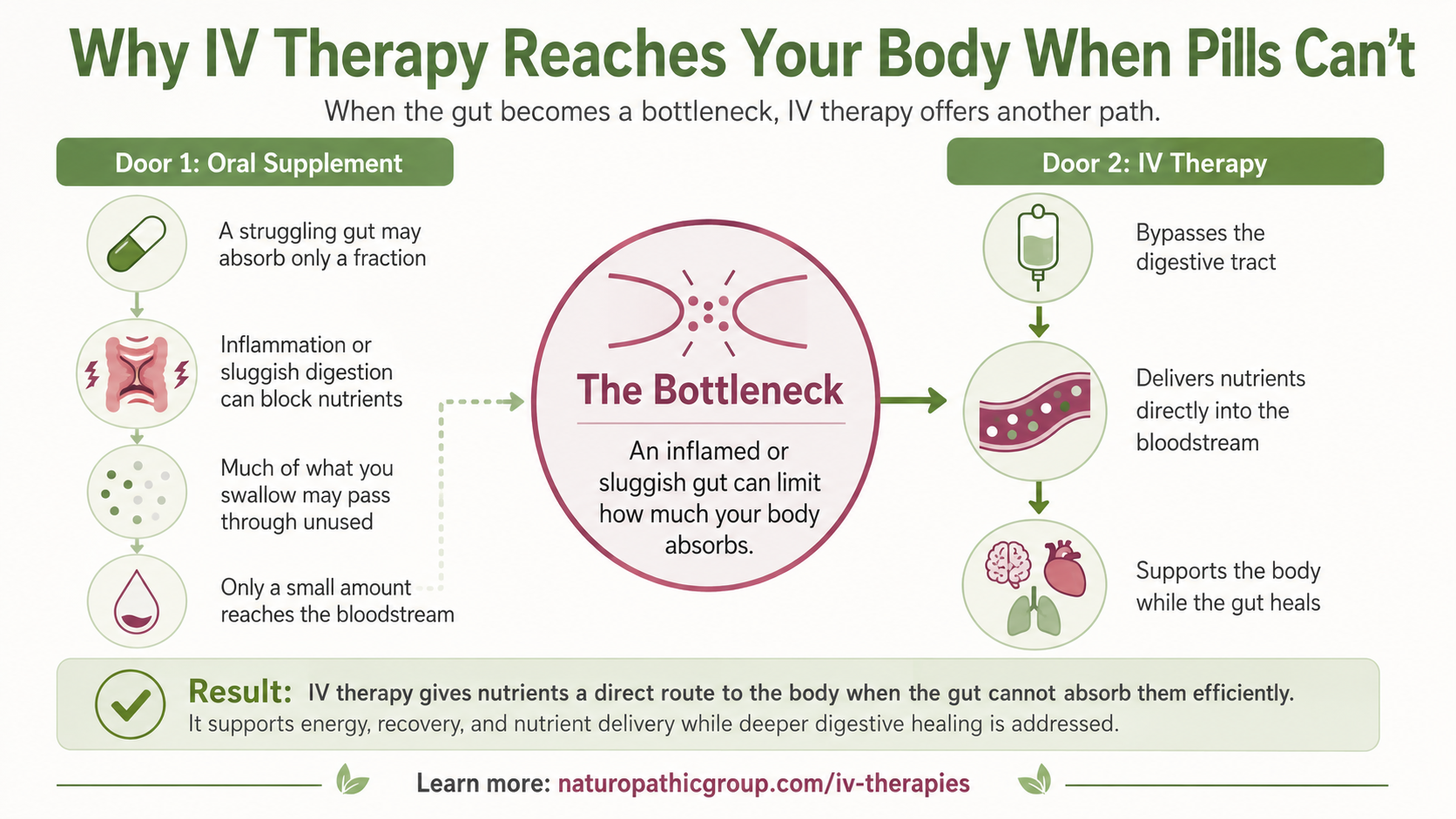
If your supplement routine never seems to pay off, you are not imagining it. For people with digestive issues, oral vitamins are often not absorbed well, and the gut itself is usually the reason. When digestion is inflamed, irritated, or sluggish, the nutrients you swallow may never fully reach your bloodstream.
As Dr. Ryder puts it, some people have digestive issues and simply do not absorb as well as they should. That is not a character flaw or a failure of willpower. It is mechanical. A struggling gut is a narrow doorway, and only a fraction of what you take gets through.
This is why so many digestive patients feel stuck. They are doing the work, spending money on quality supplements, and still running on empty. If your gut has been struggling for a long time, you may also want to read our post on the truth about IBS and gut health, because the same root issue is often driving both problems.
How IV Therapy Gets Around a Struggling Gut
IV therapy works by skipping the digestive tract entirely. Instead of asking an inflamed gut to break down and absorb a nutrient, the IV places it directly into your bloodstream, where it travels straight to your brain, heart, and other vital organs.
That direct route is the whole point for a gut patient. As Dr. Ryder explains, IV therapy is the fastest and most effective way for your body to receive nutrients, with increased absorption compared to oral supplements. When the doorway is narrow, you stop forcing nutrients through it and open a different door instead. If you want to explore the clinic's full menu of options, you can learn more on the IV therapy services page.
This matters most while you are still healing the gut itself. IV therapy is not meant to replace the deeper work of calming inflammation, adjusting diet, and addressing root causes. It supports your body and keeps your tank from running dry while that slower work happens underneath.
A Patient Whose Gut Got in the Way
The episode shared the experience of Josh, a patient who traveled to NPG from Pennsylvania while going through cancer care. His most urgent problem was not the cancer itself in that moment. It was his gut. He had developed severe colitis, an inflamed colon, that left him unable to eat or drink and depleted of vitamins, electrolytes, and energy.
His care combined several pieces. He received nutrient IV therapy and ozone treatments to support his depleted system. He worked on his diet, removing the foods most known to drive inflammation. He used a GI support powder. And he addressed the whole picture, including stress and anxiety, with tools like meditation.
Over time, his energy steadily returned. He went from struggling to climb a flight of stairs to mowing the lawn again. Every person is different, and results vary, but his story shows what can be possible when you stop fighting a broken gut and start supporting the body through a different path while you heal it.
The IV Therapies Offered at Naturopathic Physicians Group
NPG offers a range of IV therapies, many customized to your needs. Here are the most common options and what each may support. These descriptions are educational and are not a promise of any specific result for you.
The Myers cocktail, also called the nutrient IV. The most popular IV at NPG. It delivers vitamin C, B vitamins, magnesium, selenium, and zinc, and the magnesium helps carry nutrients to areas with poor circulation. Many patients report better energy and immune function, and it can act as an anti-inflammatory IV. A glutathione push, a strong antioxidant, is typically added at the end. About 45 minutes to an hour.
Ozone and hydrogen peroxide IVs. These work through a similar mechanism. The hydrogen peroxide IV may support liver metabolism, detoxification, and microcirculation. If detox and liver support are on your mind, our post on the truth about liver detox goes deeper into how the liver fits into digestion and healing.
Iron IV therapy. This provides iron directly to your body and is often considered for anemia, which is common in menstruating women. It is a longer session, around three hours, so plan to bring water and a snack.
Alpha-lipoic acid IV. An antioxidant IV that may support metabolism, nerve tissue, and circulation. Because it can affect blood sugar, it is a good idea to eat beforehand. About an hour to an hour and a half.
Neurological support IV. Covered in detail in the next section, this version is built to support brain and nervous system function.
Why the Neurological IV Is Different
One option deserves a closer look because the original conversation went deep on it and most people never hear this part. Your brain runs on chemistry, and that chemistry depends on specific nutrients called cofactors. The neurological support IV is designed around exactly these.
It is similar to the Myers cocktail but uses a different ratio, with added B vitamins, folic acid, and higher levels of magnesium and zinc. The goal is to support the chemical reactions your neurotransmitters depend on. For example, the conversion of GABA to glutamate relies on vitamin B6. The production of dopamine, serotonin, and melatonin also leans on B vitamins and on minerals like magnesium, zinc, and others.
When those cofactors are in short supply, and especially when a struggling gut is not absorbing them well, brain function can suffer. That can look like fog, fatigue, low mood, or poor sleep. Delivering these cofactors directly may support clearer thinking and steadier energy while the underlying causes are addressed. As always, this is educational and not a prescription. A personalized evaluation can help determine whether it fits your situation.
A Hospital Hydration IV Is Not the Same Thing
It helps to know what a targeted IV is not. In a standard medical setting, the most common IV is a simple hydration IV. It is usually plain saline, sometimes a lactated Ringer's solution with added electrolytes, used when someone is severely dehydrated from heat, illness, or fluid loss. Drinks like Pedialyte or Gatorade do a milder version of the same job, just more slowly.
That kind of IV replaces fluid. A targeted naturopathic IV is a different tool with a different purpose. Rather than only restoring hydration, it is built around specific nutrients chosen for your situation, and it follows the testing described below. The two are not in competition. They answer different questions.
What Testing Comes First
A responsible IV plan does not start with a needle. It starts with testing. Before any IV, NPG confirms that your kidneys are functioning properly, because an IV adds fluid to your system and your kidneys need to manage it. A simple blood test, or a recent comprehensive metabolic panel from within the past year, can show this.
From there, testing depends on the goal. If iron is the focus, the workup may include red blood cells, hemoglobin, hematocrit, iron saturation, binding capacity, and ferritin. That last one, ferritin, is your iron storage marker, and it is too often skipped in standard care. As Dr. Ryder points out, iron and ferritin should be far more routine, especially for women who lose blood every month. This testing-first approach is the difference between guessing and knowing.

A Practical Tip Worth Knowing
Here is a small, specific takeaway from the episode that applies even if you never set foot in a clinic. If you are a current or former smoker, your body needs at least 35 percent more daily vitamin C than a non-smoker. The oxidation from smoking burns through your antioxidant stores, so more vitamin C is needed to keep up. Vitamin C is also the main ingredient in the nutrient IV, which is one reason that IV is often suggested for smokers and former smokers.
Practical Next Steps
If you are considering IV therapy, a few simple habits make the experience smoother and safer.
Arrive hydrated, even though you are receiving fluid. It makes the needle easier and the drip faster.
Eat something beforehand. An empty stomach can lead to nausea during an IV.
Give yourself extra time. A typical IV takes about an hour, but some run longer depending on your veins and hydration that day.
Ask about packages. NPG offers discounted packages when you buy more than one IV at a time.
Start with testing. Confirm kidney function and any condition-specific labs before your first session.
This content is for educational purposes only and is not medical advice. Please consult a qualified healthcare provider who knows your personal history before starting any new therapy.
When to Seek Professional Support
IV therapy is generally well tolerated, with only mild and uncommon side effects such as slight discomfort or bruising at the needle site, occasional nausea, and rarely an allergic reaction. Still, it is a medical therapy and belongs in the hands of a trained provider.
Reach out for a professional evaluation if you have digestive issues and suspect poor absorption, feel persistently fatigued, struggle to recover from illness, or have been told your labs look normal while you feel far from normal. A naturopathic physician can look at the whole picture, including your gut, and help you decide whether IV therapy fits and which type makes sense.
Frequently Asked Questions
If my gut can't absorb supplements, will IV therapy fix that? IV therapy bypasses the gut so your body can receive nutrients directly, which helps in the short term. It does not heal the underlying digestive issue on its own. The goal is to support your body while you also address the root cause of the poor absorption.
Does IV therapy hurt? Most people feel only the initial needle stick, which lasts a second. After that, many patients relax, read, or even nap. Mild bruising can happen, but significant pain is not expected.
How long does an IV take? A typical IV runs about 45 minutes to an hour. Some, like an iron infusion, can take around three hours. Hydration, vein size, and arm position affect the pace, so leave extra time.
Do I need testing before an IV? Yes. At a minimum, your provider should confirm healthy kidney function before adding fluid to your system. Depending on the goal, additional labs such as ferritin may be appropriate.
Is IV therapy a cure? No. IV therapy is a supportive tool inside a personalized, whole-body plan. It is not a stand-alone cure, and results vary from person to person.
Ready to take a closer look at what your body is telling you? Dr. Steven Katz and Dr. Loreena Ryder offer personalized, root-cause evaluations for patients who are tired of being told their labs look fine.
Schedule a consultation at naturopathicgroup.com/contact
Phone: (480) 451-6161
Email: [email protected]
Location: Naturopathic Physicians Group, Scottsdale, Arizona
This content is for educational purposes only and is not medical advice. Treatment decisions should be made with a qualified healthcare provider who understands your symptoms, history, labs, and goals.